 Saluki
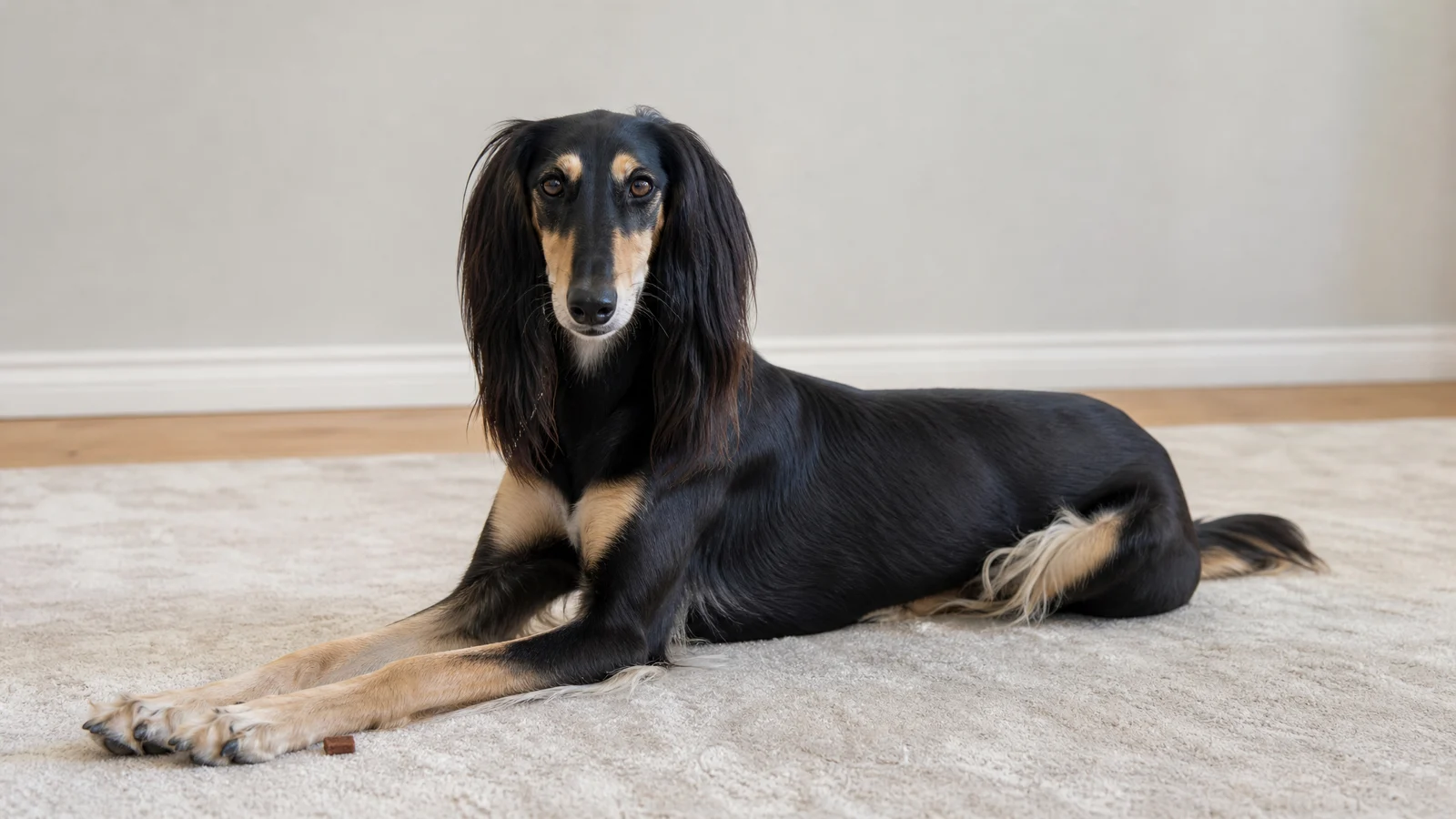
A Saluki is tall and deep through the chest, so asking for a down means asking for a long, folding trip to the floor. Your hand, your treat and your timing all have to make that trip alongside them, which is why this cue pays a slow, steady teacher back more than a quick one. You begin from a sit, bring the hips down in a second stage and only then ask from standing, after which the treat leaves your hand and a single word takes its place.
The lesson keeps that trip short at first, which is why the sections below take each stage in order, then the fixes for a down that stops halfway, and answers about toys, yards and treats.
A Tall Saluki Has a Long Way Down
The trip is long because of how the breed is built. In the UKC breed standard, males average 23 to 28 inches in height, females may be considerably smaller, and the chest is deep, long and moderately narrow. A lure that drops too fast can leave the front paws on the floor while the hips stay standing.
Starting from a sit removes the first stretch of the drop. The floor deserves a little attention too, because a tall dog stretching forward needs something to push against. Before the first treat comes out, set up four things:
- A rug or mat that grips, so the front paws do not slide during the stretch.
- Open floor ahead, free of chair legs and table bases, so a long-legged dog can reach out.
- Soft, pea-sized treats your Saluki can swallow in a second, which keeps the lesson moving.
- One marker word, such as “yes,” said the same way every time.
With those in place, the rest is moving your hand slowly enough for a deep-chested dog to follow it. The next section breaks that slow trip into three stretches.
Teach a Saluki to Lie Down in Three Stages
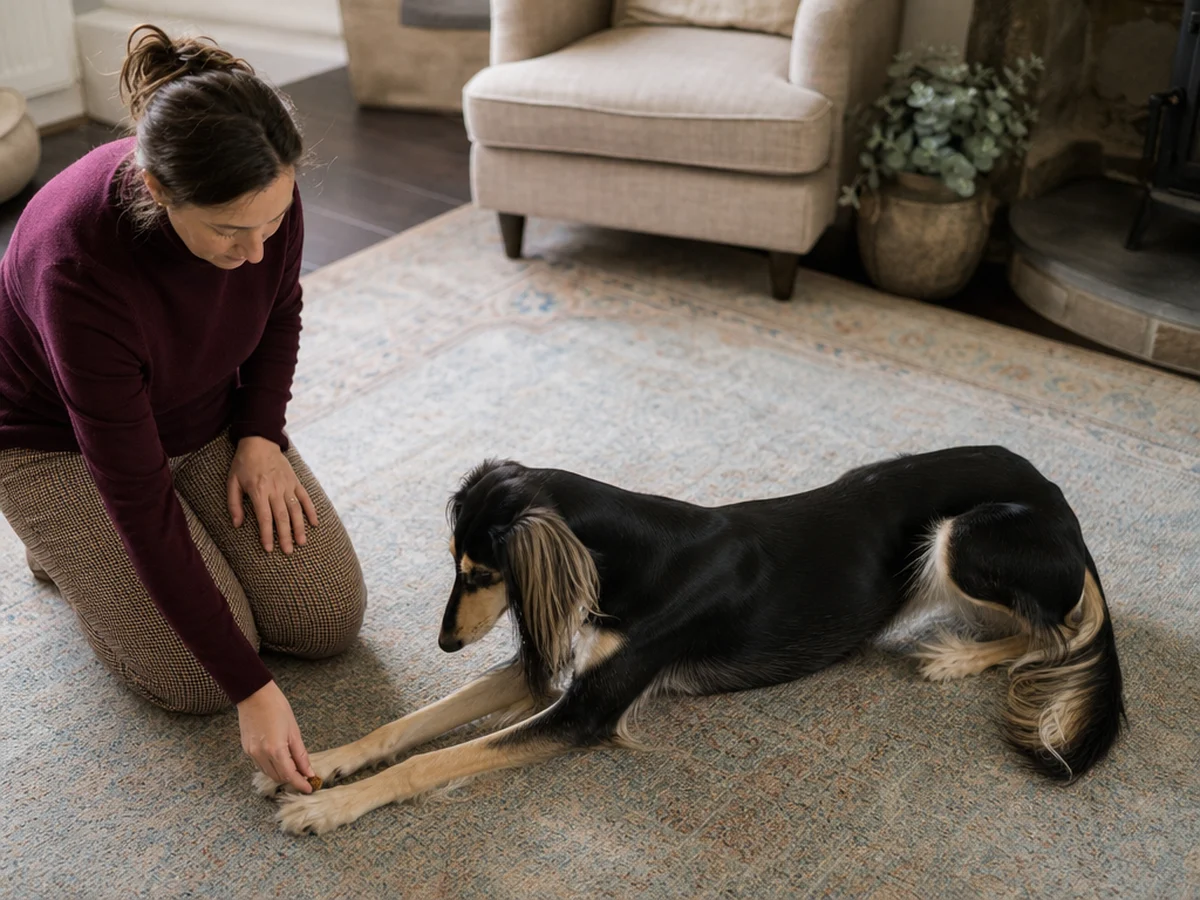
Each stretch of the trip is its own small lesson, finished when your Saluki does it smoothly several times in a row. Drop back one stage whenever a new spot or a tired dog makes the current one wobble, and if the down is among your first lessons, our guide to training a Saluki covers the wider picture.
Lowering the Front From a Sit
The first stretch is the front half of the trip, from a sit down to the elbows. Have your Saluki sit facing you on the grippy rug, then work through these steps.
- Hold a treat at your Saluki's nose and let them sniff it, without letting them take it.
- Draw the treat straight down between their front paws toward the floor, slowly enough that their nose stays with it.
- The moment their elbows touch the floor, say your marker word and give the treat there, low between the paws.
- Release with a cheerful word, let them stand, and ask for the next sit.
Paying low and at once matters, because the spot where the treat arrives shows your Saluki exactly what earned it. Move on when the elbows reach the floor smoothly several times in a row.
Bringing the Hips Along
Some Salukis fold the front and leave their hips in the air. Slide the treat slowly forward along the floor, away from the chest, so the hips have a reason to settle behind the elbows.
Mark the moment the hips touch down, even if they land tipped to one side, because as Saluki people we would rather pay an imperfect down than hold out for a perfect one. If your Saluki stands instead, pay nothing, ask for a sit and make the slide shorter on the next try, since a stand tells you the step was too big.
Starting From Standing
When the sit start is smooth, ask for the same trip from standing. The drop is longer now, so kneel or crouch beside your Saluki and let the treat travel slowly. A stand-start that stalls just means the stretch is still too long, so go back to the sit for a few easy repetitions and then try again.
Down Command Training Without the Food Lure
A down that appears only while food is leading is still a lure-down, so the next job is taking the treat out of the picture. Make the same sweeping motion with an empty hand, bring it to the floor and give the treat from your other hand after your Saluki lies down. Shrink the motion gradually, from a full sweep to a short one to a finger pointed at the floor.
Once your Saluki reliably follows that hand, the word can start riding along with it, which matches the order in the AKC's puppy basics lesson. Say it once, in a calm voice, as the hand begins to move, then give your Saluki time to answer. Repeating a cue teaches an independent hound that the word is background noise, so if the down does not come, go back to the hand motion instead of saying it again.
When a Saluki Down Stalls Halfway
Even a clean fade has off days, and one familiar wobble is a Saluki who lowers and springs straight back up. Timing is the usual suspect, which fits Humane World for Animals' advice on rewarding within seconds: a treat that arrives after the dog has stood back up can look like pay for standing. Deliver the treat the instant the elbows land, and if your Saluki is already rising, hold it back and run the repetition again.
Two other stalls look different. Match the fix to the picture, because a step that rescues one can make the other worse.
- Backing away: a Saluki who steps back as the treat drops may find the path too steep or your body too close, so sit beside them, shorten the drop and pay for any lean toward the floor.
- Sitting and staring. Waiting to be shown again can mean the lure was too quick or the treat too ordinary, so slow the hand and try something softer and smellier.
- Hesitating on a new floor is a message about the ground, so go back to the grippy rug and pay for any lowering there before you ask elsewhere.
A Saluki who lowered easily last month and now refuses every floor is worth mentioning to your veterinarian, and regular vet check-ups are the place to raise it.
Down Details for Toys, Yards and Treats
Smaller steps raise a few practical questions at the edges of the lesson: what you hold, where you practice and what you pay with. Each one changes the routine a little, and none of them needs a new method.
Can a toy replace the treat?
Yes, when your Saluki values the toy more than food. Lower it between the front paws just as you would a treat, mark the moment the elbows touch the floor, and let your Saluki enjoy it briefly as pay. Keep the toy still and low, because a wiggling toy turns the down into a game of grabbing.
What if the treat stops working?
A treat that suddenly bores your Saluki often means the lesson is too hard or the room too busy, not that your dog has lost interest in you. Try a softer, smellier treat, move somewhere quieter and start again from the sit, which shortens the trip. For the wider picture of what drives this breed, see our Saluki temperament and house rules guide.
Can we practice down outdoors?
Yes, but only on a leash or inside a secure fence, because a Saluki who spots movement can be gone before you react. Our guide to escape-proofing your yard covers the fence side, and the outdoor down will look like stage one again at first.
Down Belongs Where You Would Lie Down Too
Outdoor practice leaves one last test, and it fits every floor your Saluki will meet: would you lie down there yourself? Wet grass, gravel and sun-baked asphalt ask a tall, deep-chested hound for a lot, and a refusal in those places is a sensible answer, not stubbornness. Ask for a sit there, and save the down for dry grass, a clean porch or the rug that has always worked.
Choosing the ground well is part of the teaching, since a down that felt comfortable is easier to ask for the next time. Down is one of many cues a tall, independent hound will need, and our free e-book gives each of the others the same slow, clear steps. Leave your email with us and a copy lands in your inbox.
 Training basicsHow to Teach a Saluki to Heel
 Training basicsHow to Teach a Saluki to Leave It
 Training basicsLoose Leash Walking With a Saluki
