 Saluki
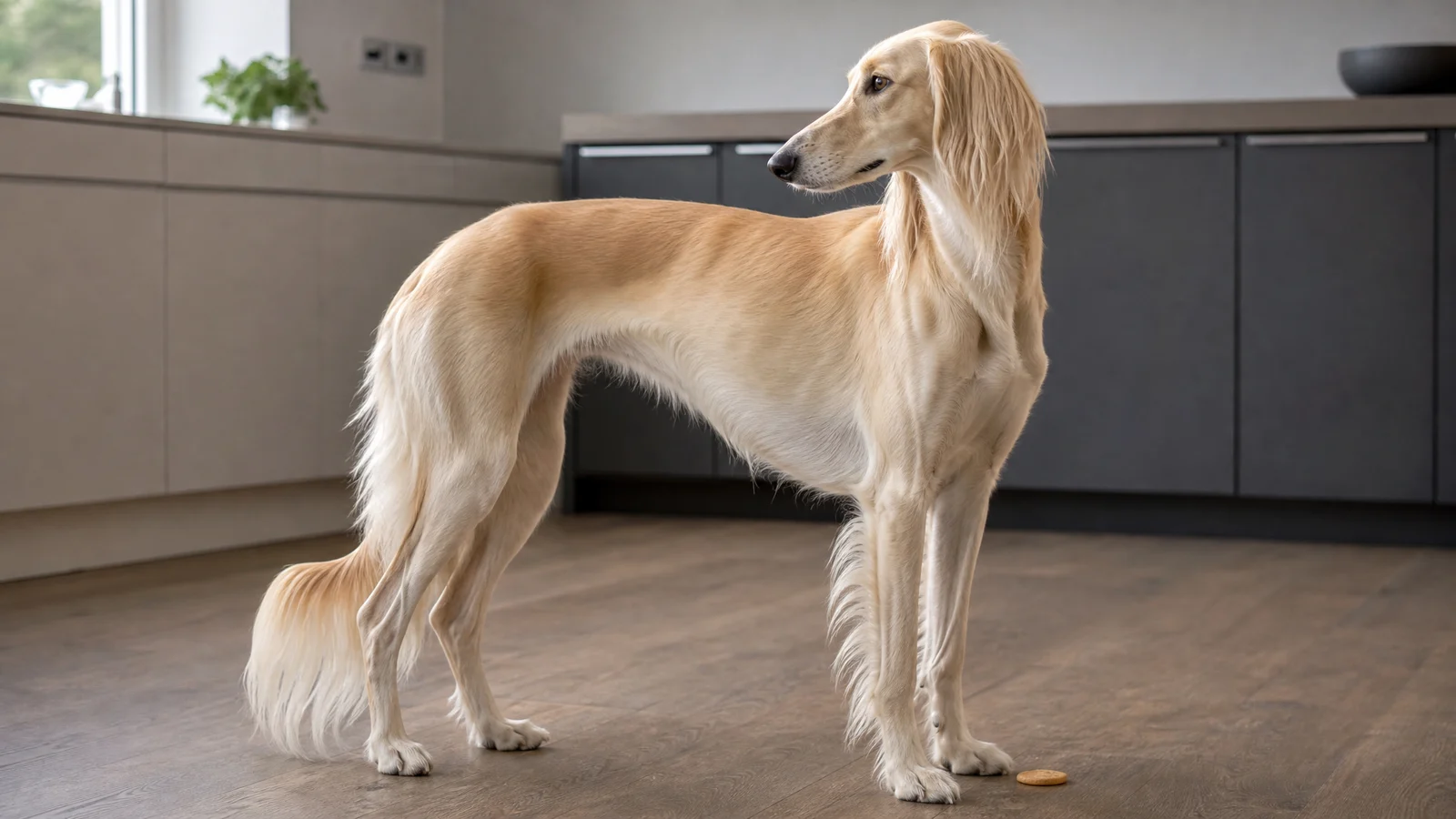
A Saluki's far-seeing eyes will find the dropped crust, the stray sock or the scrap on the sidewalk before you do. Leave it is how you answer that glance with a better offer instead of a scramble.
The lesson suits a gentle, independent-minded hound because it never asks for obedience on credit. Your Saluki turns away from something they could take, you mark the instant they do, and something better arrives from your other hand. Repeated in small steps, that exchange turns into a habit that holds in the kitchen, in the yard and on a leash.
This page covers what the cue means, how to build it from a closed hand to a treat on the floor, how to put a word on it and change the setting, and the household questions that follow.
Leave It Works Before Your Saluki's Mouth Does
The cue has one narrow job. Your Saluki turns away from something they could still take, and the item stays exactly where it lies. In the standard cue vocabulary, leave it means not touching or picking up something from the ground, while drop or give is a separate cue for trading what is already in the mouth for a treat or toy.
Keeping those jobs apart matters, because a hound who has to guess what a word means will guess wrong at the worst moment. We teach the turn away here; an item already in a mouth calls for a trade instead. Gather two kinds of treat and a few basics before the first repetition:
- A plain treat that will sit under your hand and later on the floor.
- A better treat that only ever comes from your other hand. The independent streak we describe in our Saluki temperament and house rules guide is the reason it has to beat the plain one every time.
- A regular leash and a quiet room.
Building Leave It From Closed Hand to Floor
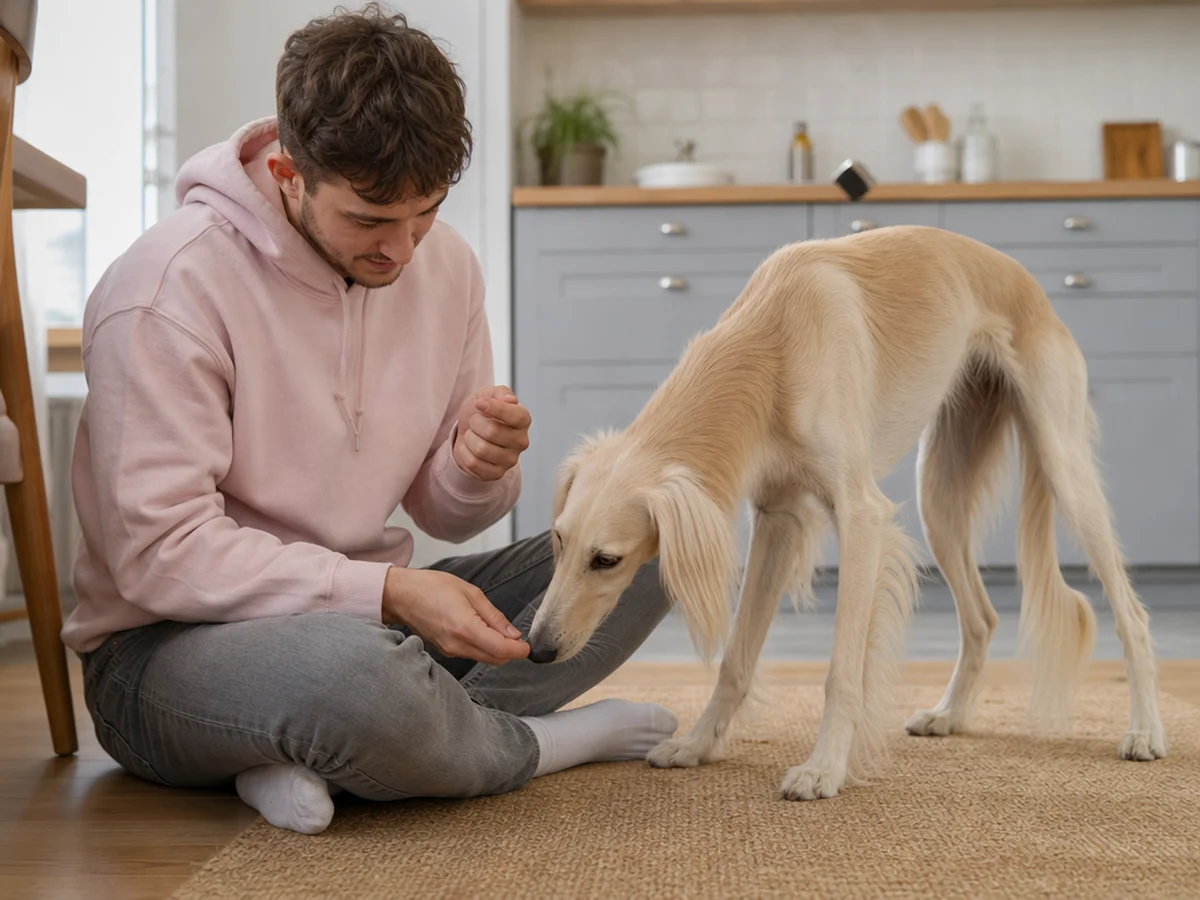
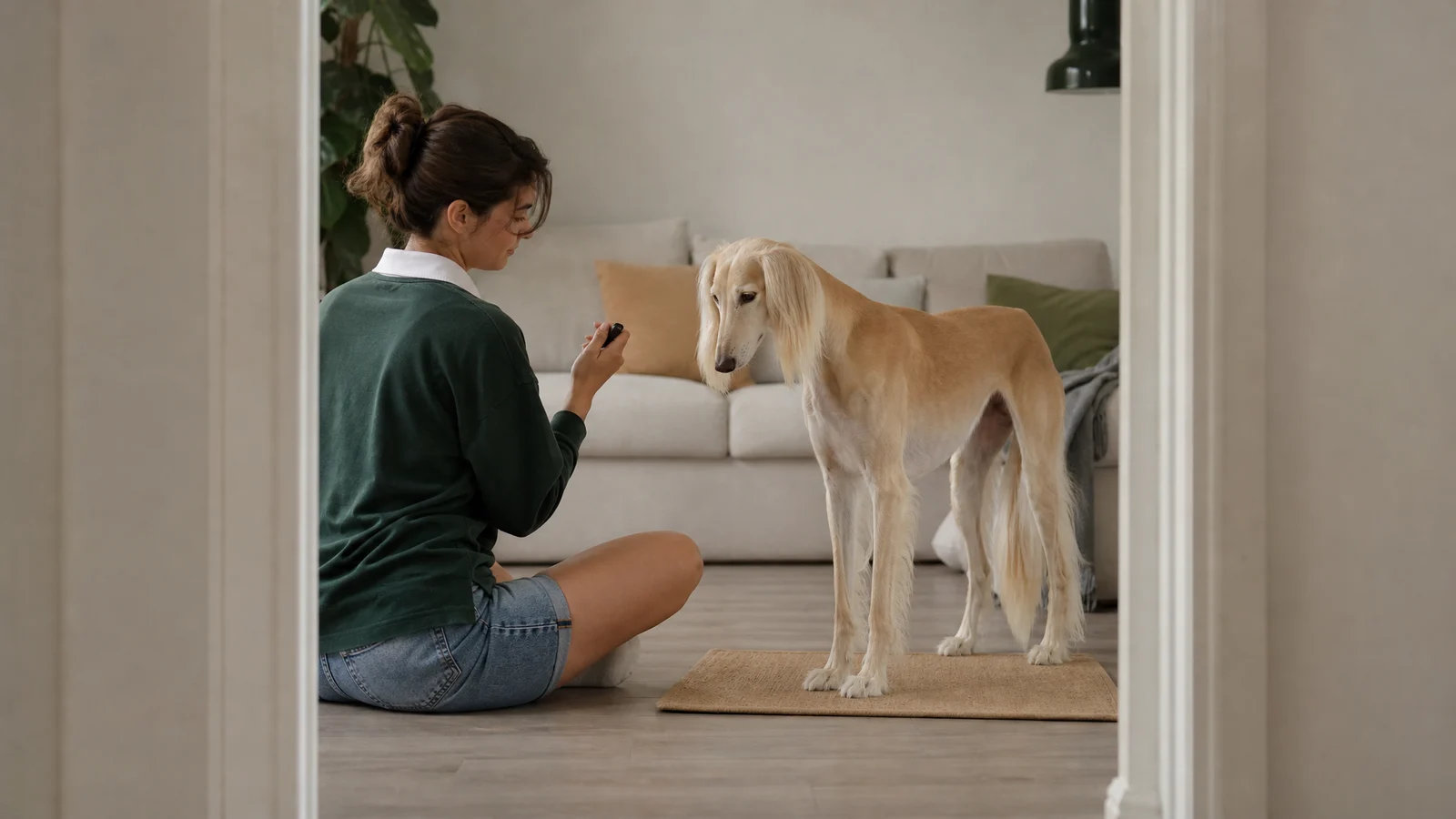
With the treats sorted, the first stage is the simplest game in the lesson, a closed hand your Saluki cannot get into. Hold the plain treat in your fist and let them sniff and paw at it while you stay still. The moment their nose pulls away, even slightly, say yes or click and pay with the better treat from your other hand.
That small retreat is the lesson in miniature. Your Saluki learns that giving up the plain treat is exactly what unlocks the better one, and because the plain treat never becomes the prize, the word stays meaningful when real items take its place.
Once the fist stops being interesting, the plain treat moves to the floor. Move on only when your Saluki handles each stage smoothly several times in a row:
- Place the plain treat on the floor and cover it with your hand, so your Saluki can see it but cannot reach it.
- When they look away or back off, mark the moment and pay with the better treat from your other hand, never with the floor treat.
- Lift your hand a little at a time, ready to cover the treat again the instant your Saluki lunges for it.
- Clip on the leash, stand up and set the plain treat a step away, then use your foot or the leash to keep it out of reach and pay every turn away.
Each step keeps the same rule, which is that the item is never the reward. A Saluki who stares hard, lunges when your hand lifts or gets to the treat first has been asked for too much too soon, so go back one step and make the task easier.
Impulse Control Training for a Saluki Beyond the Kitchen
The stakes are real. A well-taught cue might even save their life, because the things worth leaving alone include toxic foods and chemicals, broken glass, or even another animal. Regular vet visits belong alongside the lesson, and a call to your veterinarian is the right move the moment your Saluki swallows something harmful, whatever the cue was doing.
A Saluki who turns away from a covered treat already has the core of impulse control, and the next job is carrying it into rooms and routines you do not control. Three adjustments do most of that work.
Adding the Saluki Leave It Command
Put the word on the habit only once the turn away is already happening. Say leave it once, in an ordinary voice, as your Saluki's eyes first drift toward the item, then mark and pay the turn.
Timing carries the whole step, since a dog who is already intrigued by an object will find it much harder to leave it alone. A cue that arrives late is a cue that fails. If your Saluki ignores the word and goes for the item, the cue has outrun the habit, so return to the covered treat and rebuild from there.
Changing One Thing at a Time
Make the lesson harder along a single line at once. Swap the plain treat for an ordinary object your Saluki ignores, then for something they like better, such as a toy, and only then raise the value further. Move from room to room before you move outdoors, and keep every outdoor repetition on a leash or inside a secure fence, since Salukis love to run and a loose hound is no practice setting.
On a leashed walk, treat anything you did not choose the way you treated the floor treat. Shorten the leash, step between your Saluki and the item, say the cue early and pay when they turn. Leave it is built for things that lie still, and a Saluki locked on something that moves is a recall and chase-outlet question, so do not ask this cue to carry that job alone.
Leave It Doubts From Counters, Yards and Guests
Practice at a training spot rarely meets the places where a Saluki actually gets into trouble, so these four questions start from the counter, the yard, the children and the front door.
Can leave it stop counter surfing?
Not on its own. The cue answers an item that is already in view, while a counter that keeps paying out needs its own plan, which our guide to Saluki counter manners lays out with cleared surfaces and a station. Use leave it as the backup once the counter has been cleared, never as the whole fix.
Where should we practice outdoors?
Only where a leash or a secure fence is doing the safety work, because a Saluki's attention can swing away from you fast. Start in a quiet corner of the yard on a leash, then move to a short leash on sidewalks, and leave open spaces for other lessons.
Can children help with practice?
They can, with an adult running the lesson. A child can set down the plain treat or stand quietly nearby while the adult holds the leash, marks the turn and pays. Keep children's toys up and out of reach rather than using them as practice items, and give your Saluki their own Saluki chewing toys instead.
What about guests' bags and shoes?
A reserved Saluki may not take a cue from a visitor, and a guest cannot be expected to deliver pay at the right moment. Ask visitors to keep bags and shoes off the floor, and keep the cue as something between you and your dog.
A Quiet Leave It for a Dignified Hound
Whichever of those questions brought you here, the goal underneath stays the same, because a well-built leave it is quiet. There is no scramble across the kitchen, no raised voice and nothing pulled out of a mouth, only a gentle hound who turns away from the item and collects something better. That calm exchange is the standard to hold every practice session to, and it suits a Saluki, whose whole manner is dignified and unhurried.
Turning away from one crumb is a single page in a much longer education, and our Saluki e-book holds the other pages, with every training need covered thoroughly and written for a newcomer to follow. Register here and it is sent to you with nothing to pay.
 Training basicsLoose Leash Walking With a Saluki
 Training basicsHow to Teach a Saluki to Focus on You
 Training basicsClicker Training a Saluki
