 Saluki
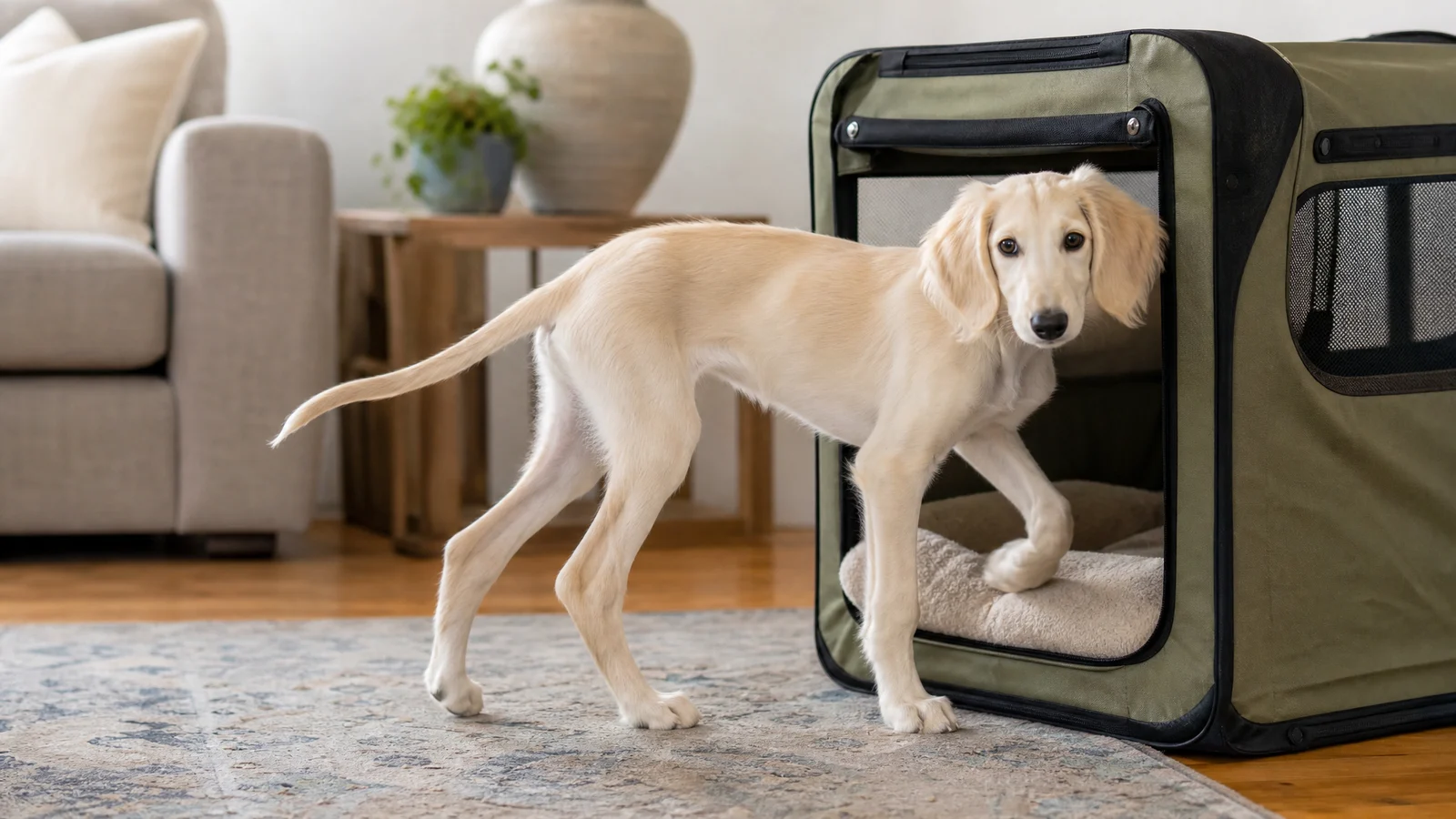
Should you ignore a Saluki puppy who cries in the crate: no single rule fits every sound because a brief complaint, an urgent need to relieve themselves, and escalating distress require different responses. The useful question is what the puppy's body is telling you.
Crate training works when comfort rises one rung at a time. The crate becomes a predictable resting place through choice, food, chews, and careful pacing, not through endurance. If comfort falls, return to the last easy rung.
Salukis can benefit from crate training for safe confinement at home or while traveling. Benefit depends on how the skill is taught. The crate must never become a place where fear is rehearsed. In this article, we climb from setup and voluntary entry through door motion, distance, and an honest reading of distress across ordinary daily life.
The Saluki Crate Training Base
Set the crate in a lived-in but not chaotic part of the home: the puppy should be able to rest without feeling isolated and observe normal household movement without being surrounded. Add comfortable bedding only if the puppy uses it safely.
Choose Space for Rest, Not Roaming
Best Friends recommends a crate that allows standing, turning, and lying down without providing a separate elimination corner. The Best Friends crate guide suggests a divider in a larger crate for a growing puppy. Recheck the fit as the Saluki's long frame develops.
Exact dimensions depend on the individual puppy and crate design, so measure rather than relying on a breed label: watch ears, shoulders, hips, and tail as the puppy changes position. Comfort is a physical requirement, not a reward for good behavior.
Define the Crate's Job
The RSPCA crate guidance says a crate should be a safe haven, never punishment or a time-out. Use it for learned rest, transport preparation, or short safe management. It is not a solution for unmet exercise, social, or relief needs.
Keep the door secured open during setup so it cannot swing against the puppy: scatter a few rewards near the entrance and let investigation happen. Do not place the puppy inside to show them what you mean.
Consider the surface under the crate as well as the surface inside it. Sliding, rattling, or rocking can surprise a light-footed puppy and contaminate an otherwise good setup. Stabilize the equipment before asking the puppy to trust it.
Watch room temperature and direct sun: a resting place can become uncomfortable even when the bedding looks inviting. Position the crate so the puppy can change posture comfortably and so an adult can observe without hovering.
Voluntary Saluki Crate Training Entry
Stand nearby without blocking the exit. Mark any willing look, step, or lean toward the crate, then deliver the reward where it supports the next choice. A cautious puppy may need many approaches before all four feet enter.
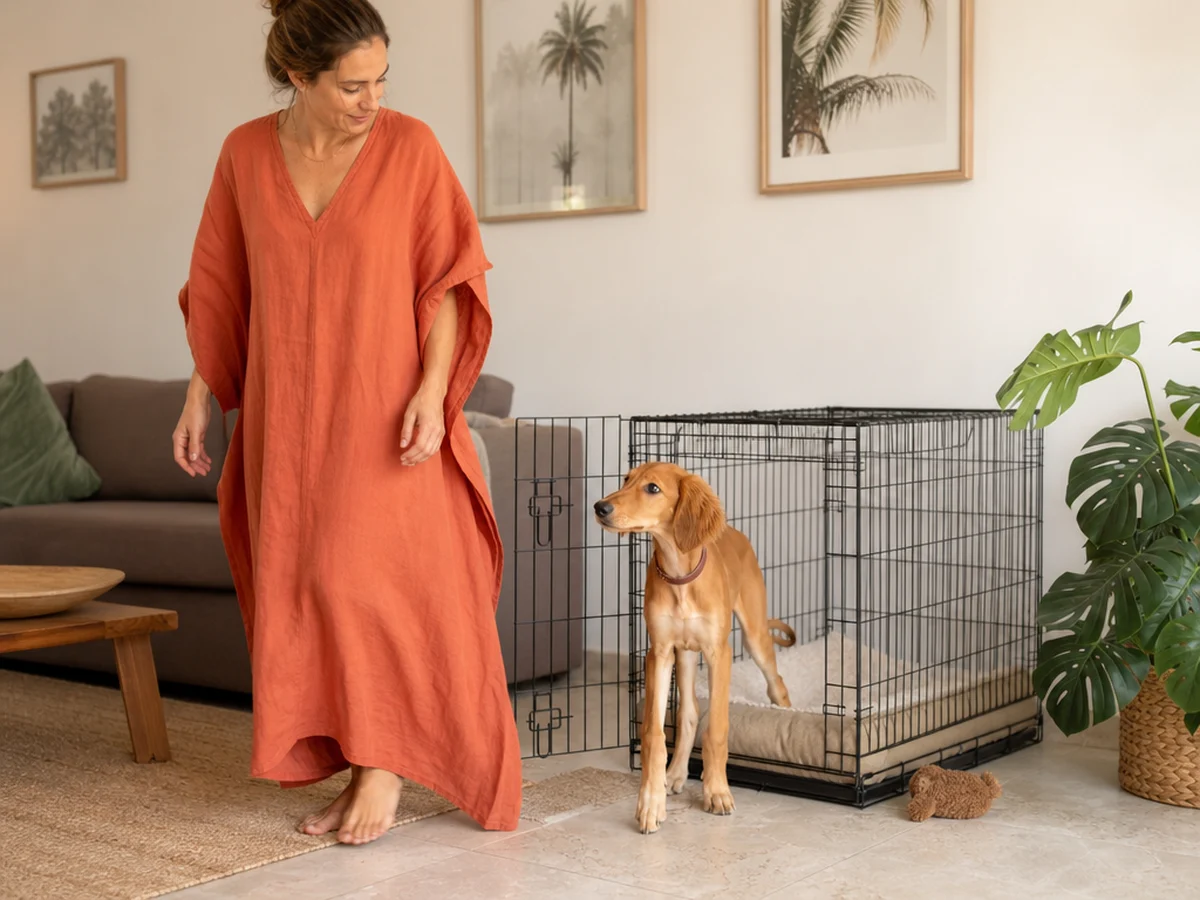
Reward the Smallest Honest Step
Begin with the criterion the puppy can meet now: that might be looking at the doorway, touching the threshold, placing one paw inside, or following a treat to the back. Raise only one piece of difficulty after several relaxed repetitions.
Salukis are described by the breed club as slow maturing, so avoid reading a puppy's temporary hesitation as a fixed trait. The club code of ethics says the breed cannot be adequately assessed before two years. Patient learning fits that longer view.
Make staying different from entering. We teach the pause as a separate choice, because walking through a doorway and remaining there ask different things of the puppy.
Once entry is easy, reward a pause inside before inviting the puppy out: then place a chew or part of a meal inside while the door remains open. Entry and staying are separate skills, so do not rush from one successful step to a long rest.
Use a release word consistently and let the puppy exit. Preventing every exit can make the doorway feel like a trap. Choice at this stage creates the confidence needed for later closure.
- The puppy approaches with a loose body and can turn away without being pursued.
- Rewards are small enough to allow several repetitions without replacing normal meals.
- The door is stable, bedding is safe, and collars or dangling gear cannot snag.
- Relief, water, movement, and social needs are addressed before a rest attempt.
- The session ends while the puppy can still succeed, not after frustration appears.
A cue for entry should be added after the action is predictable, not used to push an uncertain puppy: say it once as the puppy begins to enter, then reinforce inside. Repeating the cue while they hesitate only weakens its meaning.
Make Staying Different From Entering
Practice release as deliberately as entry. Open the door a little, close it if the puppy surges, then fully open when their body softens. The lesson is that calm makes the exit available, not that the owner will physically block them.
Door Closure in Puppy Crate Training
Door movement is its own rung: touch the door, reward, and release, then move it a little farther on later repetitions. When the puppy remains relaxed, close and reopen it before they ask for release.
Change Seconds Before Minutes
No universal nighttime or confinement timeline appears in this breed's evidence, so follow behavior rather than a promised schedule. Add duration in small, uneven increments and include easy repetitions. Progress is stronger when the puppy does not predict that every closure will be longer.
Stay nearby at first: offer a safe activity the puppy already handles well, then sit quietly rather than staring through the bars. If the body stiffens or the puppy abandons food, the step may be too difficult.
Answer Needs Without Rewarding Panic
If you suspect an urgent relief need, take the puppy out calmly and return without play. If mild vocalizing begins after needs are met, wait for a brief pause when possible, then simplify the next repetition. Never prolong obvious distress to prove a point.
Distress may include frantic escape attempts, heavy drooling, inability to take familiar food, or sustained escalation: stop and reassess the plan. A qualified reward-based professional can help distinguish a training gap from a larger separation problem.
Before changing distance, practice calm release after several different durations. Sometimes reopen almost immediately and sometimes wait a little longer while comfort remains steady. Variable easy success prevents the latch from predicting one relentless countdown.
Door practice should include the sounds the hardware makes: touch the latch, move it, and reward before actually securing it. A puppy who startles at the click needs sound work, not a longer closed-door session.
When you add duration, continue to observe posture. A puppy lying down while rigidly watching the door is not resting in the same way as one who shifts position or sighs. We advance on comfort, not merely silence.
Distance in Saluki Crate Training
A closed door while you sit beside the crate does not automatically prepare a puppy for you to leave: distance, duration, and household noise are separate variables. Change one while making the others easy.
Move Around Before You Disappear
Stand, sit, take one step, and return while the puppy stays comfortable. Later, move across the room or briefly pass out of sight. Keep departures matter-of-fact and reward calm before arousal takes over.
Use normal daypart practice from the Saluki puppy routine rather than saving every crate session for departures: a crate that predicts only isolation becomes harder to love. Some sessions should end with nothing more dramatic than a nap near you.
Generalize without surprising the puppy. A familiar crate in a different place is still a new training picture, so we rebuild confidence before asking for duration.
Travel and unfamiliar rooms change the picture. Practice with the crate in another safe area before expecting the same response away from home. Bring familiar bedding only when it is safe and supervise the first sessions in the new context.
Recheck Comfort When the Context Changes
Crate skills also fluctuate during development: a puppy may need an easier rung after a stimulating day, a growth change, or a frightening event. Adjustment is not failure, and forcing yesterday's duration can weaken tomorrow's trust.
Pair crate work with the broader first Saluki puppy lessons so entry is one familiar skill among many. The puppy still needs movement, handling practice, social learning, and ordinary time with the family. A crate cannot carry the whole training plan.
For a dependable rest rhythm, use the daily Saluki puppy routine to place crate sessions after needs are met. We prefer a puppy who arrives ready to settle over one confined in the hope that settling eventually happens.
People in the home should agree on the words for entry and release, plus the body-language signs that permit another step: mixed rules can create a puppy who enters for one person but avoids another. Consistency here means shared information, not stricter confinement.
Never use a successful afternoon nap as proof that a full night or long absence will be easy. Context changes the skill. Build each new picture with enough support that the puppy can recognize the old lesson.
We evaluate the ladder from the bottom whenever trouble appears: check physical comfort and unmet needs first, then entry, door motion, duration, distance, and context. The first weak rung is the useful place to practice.
Crate Training Results and Next Steps
A comfort ladder can move sideways as well as upward. Practice the same easy rung in a slightly different room before increasing duration again. That choice teaches flexibility without stacking two difficult changes.
Repeat an easy entry after a difficult session before ending for the day: that small success keeps the next practice from beginning with the memory of struggle. If even the easy entry is unavailable, pause and address the puppy's needs.
Green flags are ordinary and quiet. The puppy enters willingly, takes food softly, changes position, rests, and recovers easily when you move. They can also leave without exploding into frantic activity. We count that easy transition as evidence of genuine comfort, not merely tolerance.
Yellow flags include repeated refusal, mounting vocalization, scanning, or loss of interest in a familiar reward. Reduce the challenge and check the puppy's needs. Regular veterinary care matters because pain, digestive trouble, or urinary changes can alter rest and elimination.
Keep written notes brief but concrete: record the rung, location, door position, owner distance, puppy posture, and recovery. A pattern of difficulty at one rung is more actionable than a general impression that crate training is going badly.
Red flags are panic, self-injury risk, or a sudden dramatic change. Stop the exercise and consult your veterinarian, then seek an experienced force-free trainer or veterinary behavior professional as appropriate. Successful crate training should expand safety and rest, never demand that a puppy hide distress.
 CareDo Salukis Shed? Grooming and Handling Practice Made Easy
 Training basicsHow to Train a Saluki Who Would Rather Chase Than Sit
 Exercise and jobsSaluki Exercise Needs and Lure Coursing as an Outlet
