 Saluki

You have made it through the puppy months, so the question now is when the long-legged whirlwind turns into the dog sprawled across the sofa. The honest answer is later than the first birthday, and in steps rather than on one date.
A year-old Saluki can look like a grown dog and still have a teenager's judgment. Their impulse control, their comfort around people and their patience for quiet all keep developing, each on its own clock, which is why a calm Tuesday can be followed by a Wednesday of laps around the yard. That does not mean you wait. Calm builds on every quiet moment you pay for.
Read on for how calm arrives in layers, what to reward and when, how to shape the day around it, what to do when it wobbles, and why a calmer Saluki still needs a leash.
A Saluki's Calm Arrives in Layers
Calm comes as several things on different schedules, because no single age switches all of them on. There is the body settling, the mind gaining impulse control, and the comfort with people and the world beyond the fence. A Saluki can be ahead on one and behind on another, which explains a dog who rests beautifully indoors and still bolts at a flapping bag.
Salukis are slow maturing, and the Saluki club's code of ethics goes as far as saying that neither dog nor bitch can be adequately assessed before reaching two years of age. Two years is a useful horizon for you too: a Saluki who is still restless at fourteen months is not necessarily behind schedule.
General dog guidance points the same way. In the AAHA life-stage guidelines, the stretch from about six months to three years of age can be the most challenging for owners as a dog matures socially and behaviorally. Because developmental periods phase in and out gradually, those checklists are meant as a starting point, with each dog approached as an individual. So judge calm by direction, not by date.
Is your Saluki coming back down sooner, resting more easily and returning to you faster than three months ago? Our guide to slow-maturing Saluki training covers the adolescent method in full.
Paying for Calm Your Saluki Already Offers
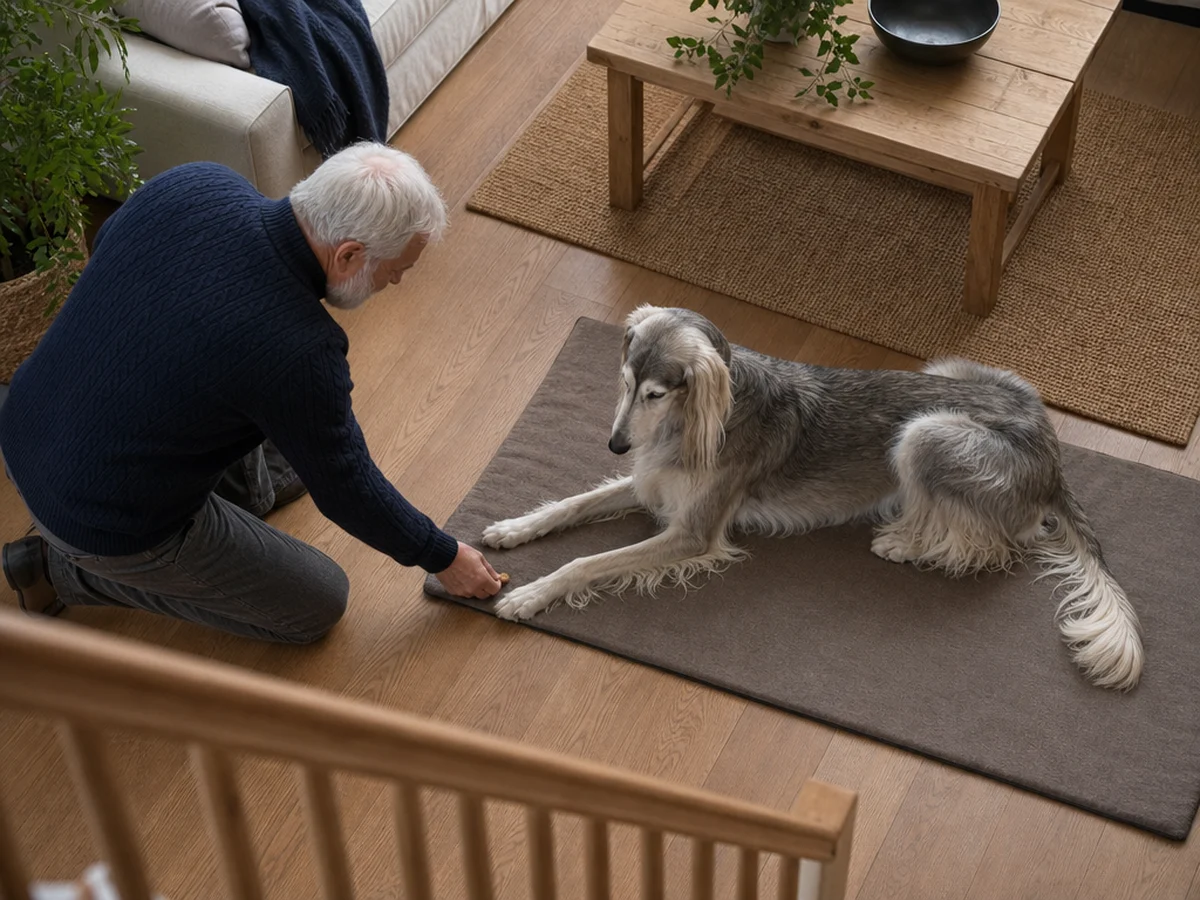
Because calm builds from what gets paid, the cheapest place to start is the calm your Saluki already shows. A chin on the floor, a long sigh, a settled stretch on the bed: these moments pass unnoticed in a busy house, and unnoticed behavior goes unpaid. Young dogs also get over-excited easily while impulse control catches up, so a reward for the quiet moment gives them something clear to repeat.
In our experience the ladder below works best when each rung stays in place until the one before it feels easy. Treat it as four small habits stacked in order, each one paid before the next begins.
- Catch it while it is free. Quietly drop a treat between the paws or praise in a low voice when your Saluki lies down on their own, and say nothing more, because a big reaction can switch the excitement back on.
- Ask for it in quiet moments: once lying down shows up often, cue it while the house is calm and pay again while your Saluki stays down.
- Add small bumps in excitement, such as a settle after a play round, before the leash comes on or as someone walks past, and pay for the first truly relaxed breath.
- Stretch the time between rewards by waiting a moment longer each round, and go back a rung if your Saluki gets up, which tells you the step was too big.
Skipping rungs is the usual reason this stalls. A Saluki who has never been paid for resting in a quiet room will not suddenly rest when a visitor arrives, and that failure says more about the step than about the dog.
A Day That Makes Calm Easier for a Saluki
The ladder works best on a dog whose day already meets their needs, because a Saluki with energy to burn cannot practice stillness for long. Sprinting is part of the breed, so the answer is a safe place to do it, not less of it. Our guides to Saluki exercise needs and safe Saluki chase outlets cover where that can happen, so here the focus is on what surrounds the run.
A day built for calm usually has three parts. None of them is exotic, but each is easier to skip than to keep.
- A safe sprint. A fenced space or a long line gives the chase drive somewhere to go, and daily walks on a leash cover the rest of the exercise.
- Mind work: a hidden-treat game or a short training session gives an intelligent, independent-minded dog something to do with their nose and brain.
- Rest on purpose in a bed or mat spot where nothing is asked of them, with a gate or door set so that quiet is the easy choice.
The middle item deserves more credit than it gets. A hidden treat or toy is a good place to start, and shaping and clicker games add variety, because exercising a young dog's mind will wear them out faster than any physical exercise. Break each new skill into small steps, and even five minutes of training a day can do wonders. A short, interesting session after the sprint is often what lets the run end in rest instead of in more searching for something to do.
When Calm Wobbles Around People and Play
Even with a good day and a rehearsed settle, calm can wobble once your Saluki's social side starts to change. Social maturity arrives later than physical size, at one to three years of age in the Animal Humane Society's terms, and that is when a dog's social circle can shrink. With that maturity, a dog may be less interested in playing, or they might play more roughly when excited.
Watch body language to tell which you have: an open mouth, a wiggly body and play bows are good signs, and a stiff body is the moment to step in and let them settle, even if the tail is still wagging.
Visitors and Unfamiliar People
Strangers can bring a wobble of their own. Salukis are reserved with strangers by nature, and even a friendly young dog may show some fear of them as they get older. The mistake we keep seeing is pushing a hesitant dog toward the visitor to prove they are fine. Give distance instead, drop a tasty treat while the visitor is still comfortably far away, and let the visitor move on. Punishing a bark or a backing away teaches nothing about being unafraid.
Cues can slip at this age too, and it is rarely defiance: a dog with an unfinished sense of self-control may simply stop answering a cue they knew at six months. Go back a rung, pay generously, and let a few easy repeats rebuild the habit before you ask for it around visitors or the fence. Our reserved Saluki visitor guide walks through the visitor side step by step.
What Owners Ask About a Year-Old Saluki's Calm
A few loose ends remain, mostly about judging progress and knowing when to ask for help. The answers are short on purpose.
How will I know calm is improving?
Look at how quickly your Saluki comes back down after something exciting, how often they lie down without being asked, and how soon they return to you after a sprint. Progress shows up as shorter wobbles, not an absence of them, so a good week and a rough week can both sit inside the same upward line.
Should a calmer Saluki get less exercise?
Usually not. The calm you are building depends on exercise and mental work staying in the day, and a Saluki who is bored or unhappy at home can turn to escaping or destructive chewing. Keep both in the routine and adjust the mix as your dog matures.
When should I ask for outside help?
Call a reward-based trainer when progress stalls for weeks or the wobbles around people or play feel hard to read. Tell your veterinarian about anything that seems new, such as a sudden change in energy or mood, and keep regular vet visits on the calendar either way.
A Calmer Saluki Still Chases
The calm you are paying for changes how your Saluki rests, recovers and meets people, but it does not remove what the breed is. A Saluki who sleeps through dinner is still ready to go after anything that moves, so the fence, the leash and the safe places to run stay in your routine long after the restlessness fades.
That is not a failure of calm. It is calm with brakes, and the brakes are what you have been building: a dog who can come down from the window, the sprint and the visitor, and who does it a little sooner as the months go by.
Our Saluki e-book carries this second-year thinking into the lessons still ahead: join the list here and a copy is sent to you by email, written in the same patient, reward-based style.
 BehaviorTraining an Older or Adopted Saluki
 Puppy trainingHow to House Train a Saluki Puppy
 Puppy trainingHow to Stop Saluki Puppy Biting
