 Saluki
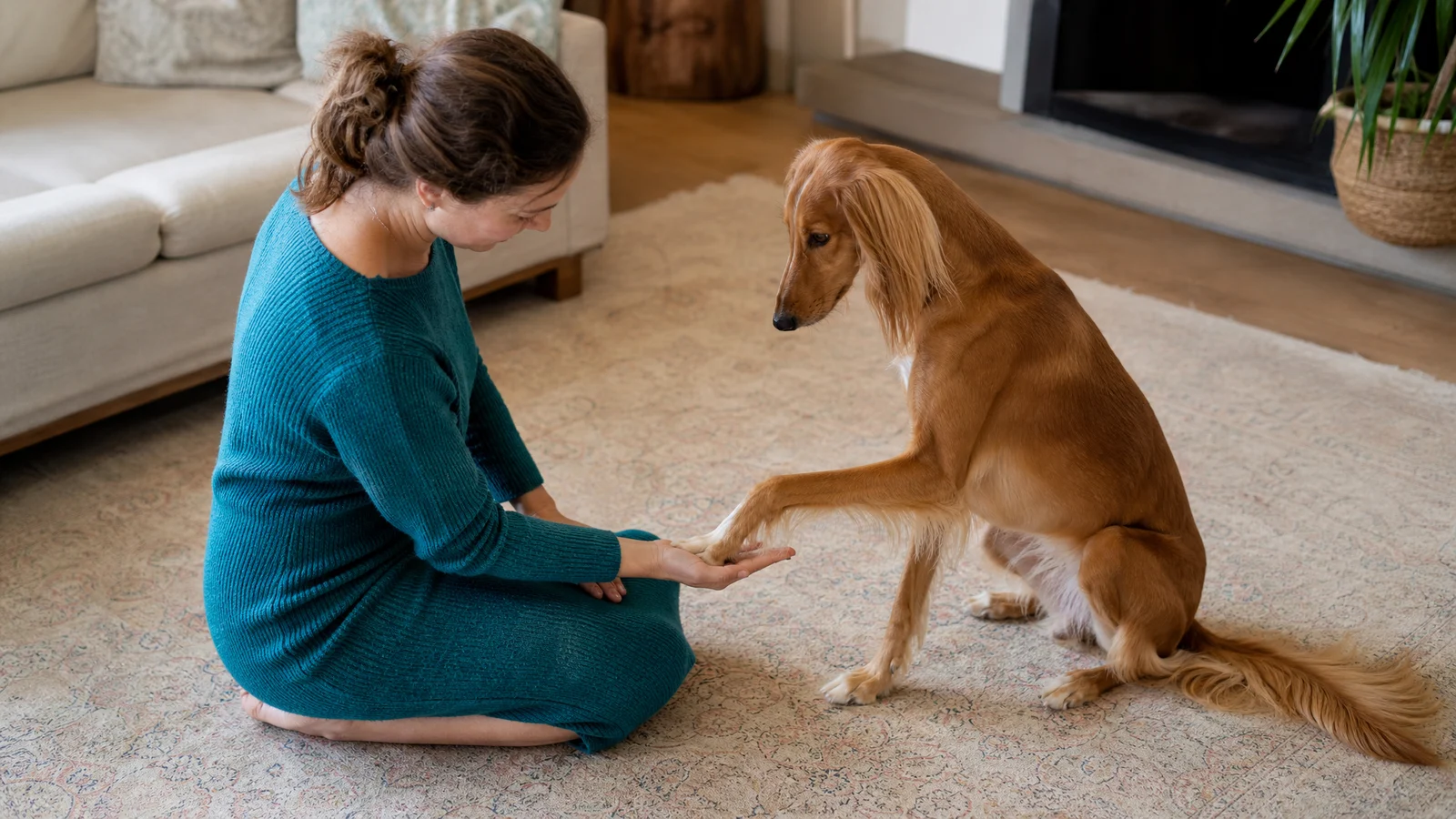
Shake is a trick visitors love to ask for, and a Saluki can learn it without being held, hurried or handled. The only thing your hound has to decide is that a paw in your palm is worth the trip.
Everything below rests on that choice. Your hand stays low and still, every small move toward a touch gets paid, and the paw always travels to you. An invitation fits an independent hound better than a demand, and a high five turns out to be the same paw landing on a palm turned upright.
Because a Saluki can walk away from any lesson, the first minutes count most. This guide covers the setup, four short stages from a lifted paw to a resting paw, and the palm change that makes a high five.
The Saluki Shake Hands Trick Starts With Your Hand
That low, still hand is the only equipment the trick needs. A finished shake is one front paw set on an open palm and left there for a moment, offered by your dog with no pull from you. Nothing in it needs speed, height or a long run, which makes it a calm first trick for a dignified hound with long legs and strong opinions.
Floor, Treats and a Quiet View
Pick a room where a long-legged dog can stand without sliding, because lifting a front paw moves weight onto the other three. Keep tiny soft treats in your free hand, and turn your Saluki away from the window: a hound with far-seeing eyes has no attention left for your palm while the street is in view.
Say your usual marker word, such as “yes,” the instant a paw moves, and pay from the treat hand right after. Outdoors can wait until the paw is dependable, and a Saluki's outdoors always means a fenced space or a leash.
Teaching a Saluki to Shake in Four Stages
With the room ready, the lesson becomes a waiting game made of four small jobs, built the way any new trick is built: a very easy version first, then one a bit closer, until you reach the finished trick. Move to the next stage when your dog does the current one smoothly several times in a row, and drop back a stage whenever the paw stops coming.
Start With a Weight Shift
Hold one open, empty hand low and still, where your dog can touch it without reaching up, and keep your treats in the other hand out of sight, so the palm is the only thing to look at. A Saluki will probably sniff or lick the palm first, and neither earns anything, so wait. The instant a front paw moves, even if it is only a shift of weight, say your marker and pay from the other hand.
Pay those first small movements generously, and move on once a lift comes almost every time the hand appears. If nothing moves, ask for less: pay a glance at the hand, then a lean toward it, then a shift of weight. In our experience, a Saluki who wanders off is often saying the pay came too late, so tighten your timing before you blame the dog.
Let the Paw Find Your Palm
Keep the hand exactly where it is and wait for a little more: the paw reaching the palm. Mark the instant a paw touches, even if it only brushes a finger, and pay from the other hand. Never pick up the paw or move your hand to meet it, because the trick only belongs to your Saluki when the paw does the traveling.
Move on when the paw lands on your palm without searching. If it swipes at the air beside your hand, slide the palm a little toward it and keep paying every touch. If your dog lies down instead, wait quietly or move to a new spot. Holding or trimming a paw is a different skill, taught in our Saluki handling practice guide.
Hold Still While the Paw Rests
Once touches are steady, wait a beat longer before you mark so the paw settles on your palm instead of tapping and leaving. Start with the paw resting for only a moment and lengthen it slowly. That brief rest is what separates a shake from a swipe, and it gives you time to mark while the paw is still down. Move on when the rest is steady. If the paw pops off the instant it lands, mark a shade earlier, pay, and stretch the rest again in smaller steps.
Turn the Palm Sideways for a Handshake
Now rotate your hand a little at a time until the palm is sideways with the thumb up, the way you would offer a handshake. Keep the treat hand out of sight so it never becomes the target, and pay every paw that lands. A Saluki may keep pawing the old flat position for a while, and that is fine: wait, then pay the touches that meet the new angle.
Move on when the paw meets the sideways palm and rests there on its own. If it stalls, go back to a flatter palm for a few rounds, then tilt again by less.
Turning a Saluki Handshake Into a High Five Trick
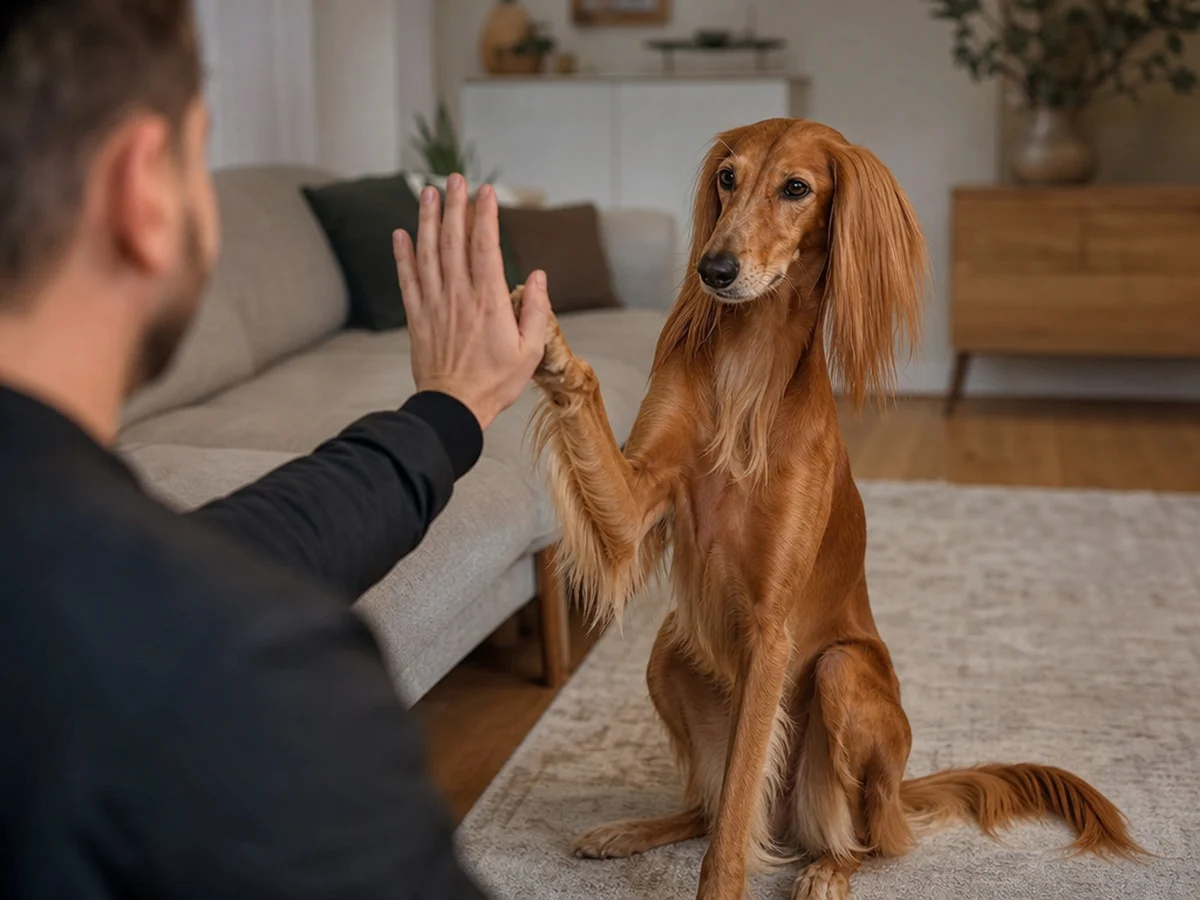
A shake that lands on a sideways palm is already most of a high five, because the paw knows where your hand lives and only the angle changes. Keep the palm no higher than your Saluki's chest, so all four feet stay down and the trick stays a paw lift instead of a jump. Change the angle gradually:
- Offer the sideways palm and pay a shake, so the paw is already on its way.
- Before each repetition, tilt the palm a little more upright, and pay every touch to it.
- When the palm faces your dog fully upright, hold it still and pay the touch exactly as you paid the shake.
- If the paw stops arriving, tilt back to the angle that worked and pay there for a few rounds.
Once the palm reaches an upright high five position, you are working with one paw and two hand pictures, sideways for shake and upright for high five. Keeping them distinct is what lets your Saluki tell the tricks apart when the words arrive.
A Name for the Shake and a Plan for the Treats
When the paw lands and rests every time, the trick is ready for a name, and the name only works if it arrives before the paw instead of chasing it. Say “shake” once as you present the sideways palm, then pay the paw as before. Give “high five” its own word with the upright palm, so each hand picture and word pair up.
Treats can thin out once a word is working. Pay every shake for a while, then most of them, and let a warm voice carry the rest, so the food becomes a pleasant surprise instead of a requirement.
Then take the trick on the road in small steps. Ask in a second room, then a third, and add small diversions, such as another family member in the room, before you try a busier moment. A reserved Saluki may decline a stranger's hand, and that is an honest answer, so let a visitor hold out a low, open palm and wait without asking for anything.
Paw Offer Problems Outside the Four Stages
A few households bend the plan: a hound who keeps their distance, a favorite cushion and an adopted adult with a past nobody wrote down. Each one changes the setup more than the method.
What if my Saluki steps away from my hand?
Take the ask down to nothing. Rest your hand on the floor beside you, pay your dog for glancing at it, then for sniffing it, and let them choose the distance. Keep the hand low and slow, and never follow the dog with it. A reserved puppy needs the same pace, and our guide to socializing a reserved Saluki puppy covers it.
Can we practice shake from the couch?
Not at first. A soft cushion shifts when weight moves onto three legs, and a wobbling paw is hard to pay accurately. Once the shake is steady on a firm floor, the couch is fine.
Can an adopted adult Saluki still learn shake?
Yes. Age and history change the pace, not the method, so the same four stages apply and you can take as long on each as your dog needs. If lifting a paw ever seems to bother them, stop and ask your veterinarian before trying again, and keep up regular veterinary visits either way.
Why a Shake Is Measured in Inches
Each fix above makes the lesson smaller, and small is where this trick lives. Most of a Saluki's training is about distance: how far a recall has to reach, how tall a fence must stand, how much room a sprint needs. Shake is the opposite kind of lesson, with a paw that travels a few inches to a hand that never moves.
That makes it a lesson you can teach anywhere, because a patch of floor no bigger than a bath mat is room enough. When the paw arrives gently and waits, a hound built for the horizon is working in the space of your hand.
Everything else a Saluki needs to learn is bigger than this, and our Saluki e-book handles all of it, thoroughly yet in simple language, for anyone who signs up with an email address here.
 Exercise and jobsHow to Teach a Saluki to Spin
 Exercise and jobsHow to Teach a Saluki to Roll Over
 Exercise and jobsHow to Teach a Saluki to Weave Through Your Legs
