 Saluki
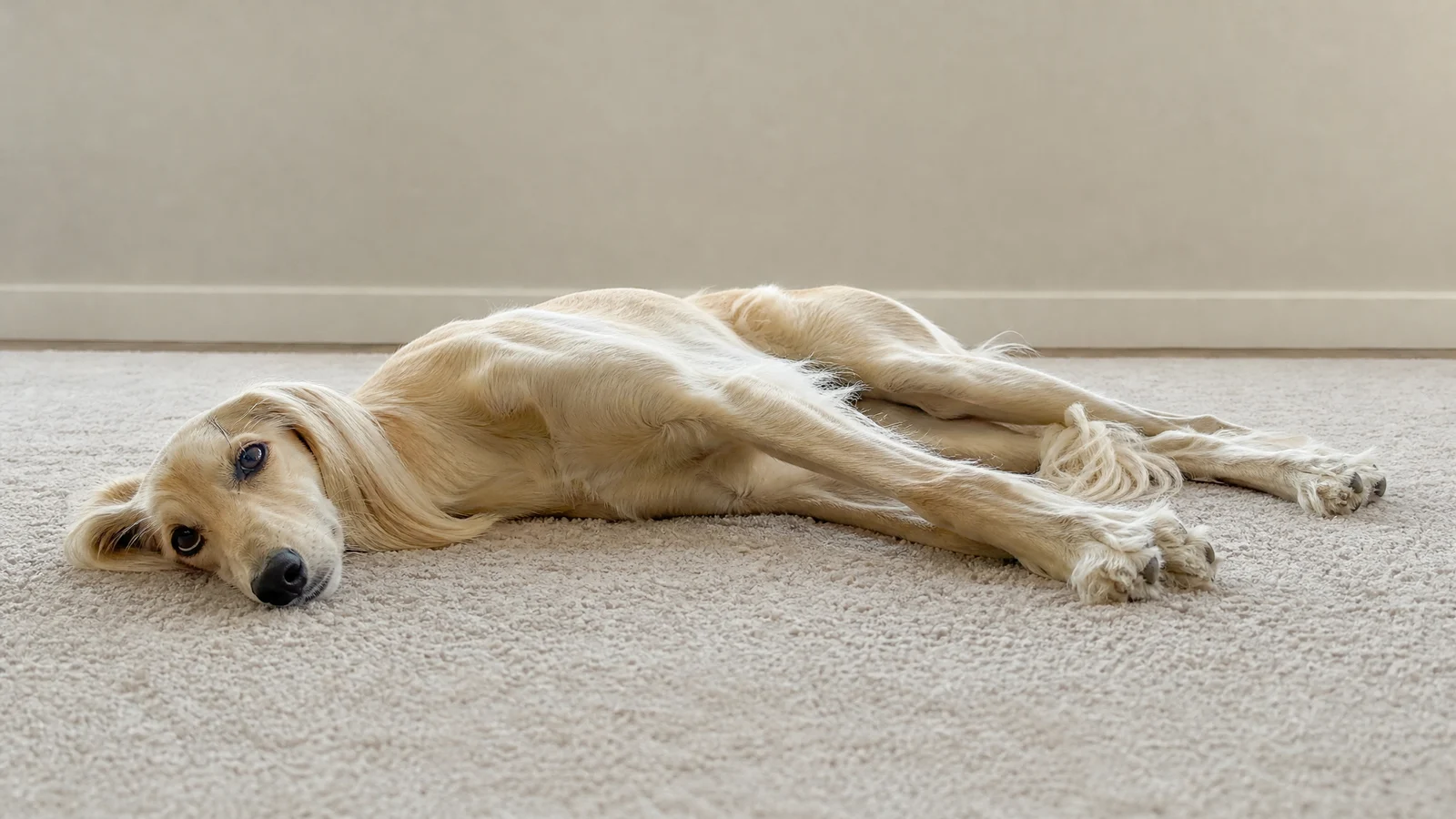
You never have to push a Saluki over, and you should not try. A slow treat carried in an arc does the teaching, and your Saluki's body follows it.
Roll over is really four positions in a row: a down, a lie on one hip, a turn onto the back and a finish on the other side. Each is a small lesson of its own, and a reserved, independent hound will only attempt the next when the last one feels safe, which is why the lesson goes in small pieces instead of one big flip. Below you'll find how to set up the room, how to teach each position, and what to do when one of them stalls.
What Roll Over Asks Beyond Other Saluki Tricks
Those four positions are what set roll over apart from a trick like shake, which only borrows a paw. Here the whole body goes somewhere the eyes cannot follow: onto the spine, legs up, with the room upside down for a moment.
A Reserved Hound and an Exposed Back
A Saluki is dignified, gentle and independent-minded, and that shows most clearly in a lesson like this, because a hound who is also reserved with strangers will not hand over their back to a lesson that feels crowded.
A Trick That Can Stop Short
The good news is that the trick does not have to be all or nothing. A Saluki who settles onto one hip for a treat and goes no further still has a real trick, and the side lie can carry its own cue. Each position can be a stopping point:
- A down held for a few relaxed seconds.
- A lie on one hip.
- A turn onto the back.
- A finish on the other side.
Start from a down your Saluki can hold for a few relaxed seconds, because every later position leans on it, and spend more time on the down first if it still wobbles.
Picking a Floor and a Treat Worth Rolling For
Because the middle of the trick puts your Saluki on their back, the room matters before the treat does. Choose a quiet room with the door closed and the blinds low, since a hound who is always ready to chase whatever moves will be on their feet the moment something crosses the window. Lay a folded blanket or a yoga mat on a floor that does not slide, and leave enough clear space for long legs to stretch out on both sides.
A Saluki who already accepts calm handling, which is what our Saluki handling practice builds, will settle into all of this faster. Then choose the reward. A small, soft treat your Saluki truly wants matters more than the particular food, and plain praise usually will not carry a trick that asks for this much trust.
Plan on short, enjoyable sessions that never run past five minutes, and stop while your Saluki is still interested. Pick a marker word too, such as a bright "yes," and say it the instant your Saluki's body does what you wanted so the treat always follows the right moment.
A game with no job is also a good place for an independent hound to practice working with you for the pleasure of it, and that habit travels into the lessons that do matter. Mention the trick at your regular vet visits, and ask before adding it if your hound ever seems stiff or sore.
Teaching a Saluki to Roll Over From Down to Far Side
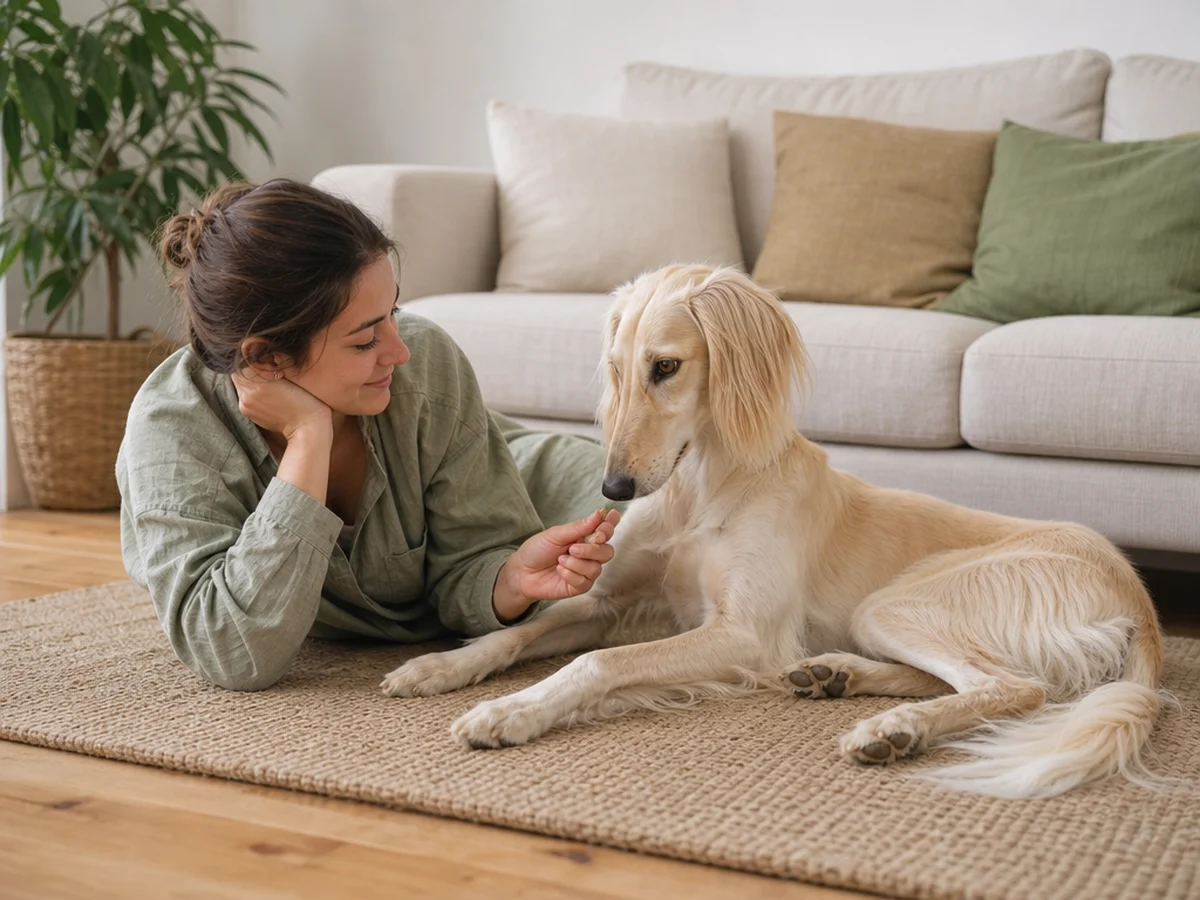
With the room ready, the trick becomes one treat traveling a path with three turns, and each turn gets its own lesson. The order follows the AKC's roll-over lesson, which leads the dog from a down onto one side, over the back and onto the other side before the word is added and the lure is faded, and which calls a known down helpful before you start.
We split the path because a long-legged hound can follow a treat with their head all the way around and still have no idea what their hips are meant to do. Kneel beside your Saluki, keep the treat at nose level and move it slowly enough for the whole body to keep up.
Down to the Side Lie
Everything starts from the down, so the first lesson only asks your Saluki to tip onto one hip. Work through it in this order.
- Ask for a down and wait until your Saluki is settled, with their chin low and their body quiet.
- Hold a treat at their nose and draw it slowly back along the cheek toward the shoulder, just above the floor.
- The moment a hip drops and the body tips, say your marker word and give the treat while your Saluki is still lying there.
- Let them stand, ask for a fresh down and begin again from the first step.
Move on when your Saluki tips onto the hip smoothly several times in a row without scrambling up. If they stand every time the treat moves, the arc is too big or too fast, so pay for a smaller lean first, even just a shift of weight, and ask for a little more each round.
Side Lie Onto the Back
Once the hip drop is easy, the middle lesson asks for the biggest change, which is weight moving from the hip onto the spine. Begin in the side lie with the treat at your Saluki's nose, then draw it slowly from the shoulder toward the backbone so the head follows over the shoulder and the ribs tip with it. Mark the moment their shoulders touch the floor on their back, even for a heartbeat, and pay while they are still there.
Keep your own hands out of the way and let the treat do all the guiding, because this is the position that feels most exposed to a reserved hound. If your Saluki pops up or goes stiff, the lure moved too fast, so pay the side lie again and ask for only a little more tilt. Move on once they land on their back with soft legs rather than braced ones, several times in a row.
Over the Back to the Far Side
A Saluki who rests easily on their back has already done the hard part, since what remains is a continuation of the same arc. Here is how to finish the turn.
- Start with your Saluki resting on their back and the treat at their nose.
- Carry the treat on past the backbone toward the far shoulder, close to the face, so the head leads and the hips follow.
- Mark when the body turns over onto the far side, and pay with your Saluki lying flat.
- Release them, reset to a down and keep to the same direction while you are still learning.
When your Saluki follows the treat from the down all the way around in one smooth sweep, several times in a row, you have the whole trick. If the turn stalls on the back, widen the sweep and slow down, because a tall dog has more leg to swing over than a small one.
Adding the Roll Over Word and Thinning the Lure
A Saluki who rolls all the way around every time has learned the path but not the word, so the word comes next. Say "roll over" once, just before your hand begins to move, then lure exactly as before. After enough pairings the word starts to predict the sweep, and that is the moment to make your hand smaller.
Shrink it a little at a time: the long sweep becomes a half arc, then a single pointed finger, then a small circle at your Saluki's nose, always paid while they still finish the whole turn. If the roll falls apart, give some of the motion back, because the hand is still a helpful guide.
Only when the word works with a tiny signal should you try a second room, then a different floor. We expect the first new room to feel like starting over, since your Saluki learned this in one place, and visitors or noise go last and one at a time.
Rolling Over Details Worth Settling
Three details sit around the stages instead of inside them: who is watching, how old your dog is and what a sudden refusal means. The answers below take each in turn.
Can a reserved Saluki roll over for guests?
Wait until the trick is easy in a quiet room, and even then let your Saluki decide. A stranger standing over an exposed belly feels very different to a reserved hound than a family member kneeling beside them, so ask guests to watch from across the room and pay your Saluki for finishing without being crowded. If they hesitate, skip the show, and our guide to socializing a reserved Saluki covers easing a hound into company.
Can a young Saluki learn to roll over?
Yes, the lure-and-reward method suits a young Saluki as long as the lessons stay short and the floor stays soft. This is a slow-maturing breed, so expect focus to come and go, much as it does around Salukis at six months. If you are unsure whether a growing body is ready for floor tricks, ask your vet at the next regular visit.
What if my Saluki suddenly refuses to roll?
Treat it as a question for your vet before it becomes a training problem. In a mature dog, and barring a frightening event, a sudden change in behavior is one of the earliest signs of a change in physical health. Pause the lessons and book a visit before you ask for the position again.
A Roll Over Is the Lesson With Nothing at Stake
Whichever of those answers fits your household, notice what sets this lesson apart from the rest of a Saluki's schooling. The stay at the gate, the leave it on the sidewalk and the slack leash all carry safety weight, and a slip in any of them can matter. Roll over carries none, so sessions can be short, silly and uneven, and a half roll can earn the same treat as a whole one on an off day.
Nothing is riding on this lesson, which makes it a pleasant preview of how we teach all the rest, and our free Saluki e-book carries that unhurried style across every other lesson a sighthound needs, worded for newcomers and covering gate manners to the long walk home. Leave your address in the form on any page and a copy is yours.
 Exercise and jobsHow to Teach a Saluki to Weave Through Your Legs
 Exercise and jobsHow to Teach a Saluki to Jump Over Obstacles
 Training basicsIs a Saluki the Right Dog for You? What Training Takes
