 Saluki
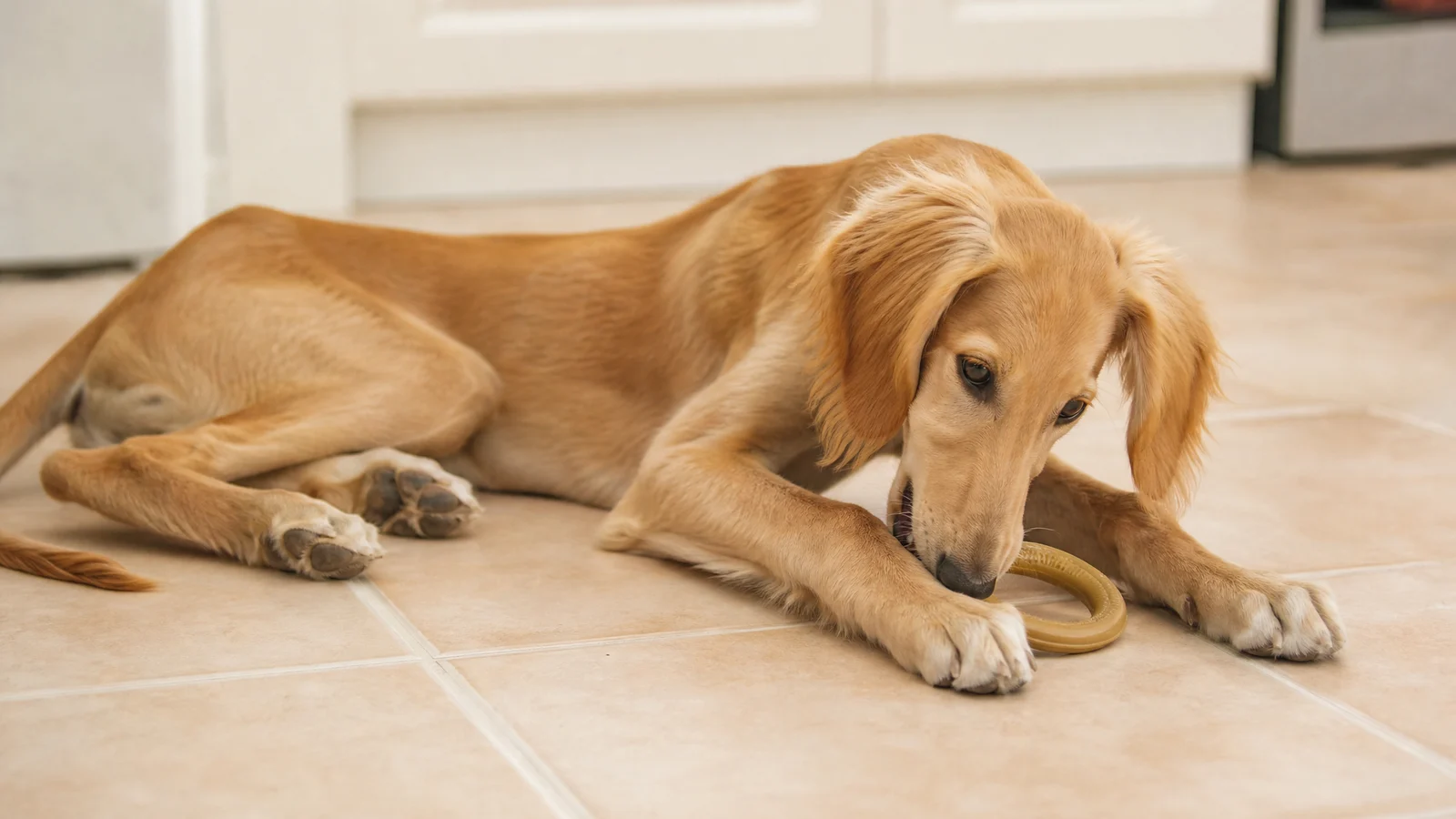
A Saluki puppy at three to four months is mostly legs, curiosity and a mouth that wants something to work on. Hems, shoelaces, table legs and your sleeve all look equally promising.
That does not make this a problem puppy. Baby teeth are being replaced, so a good share of the chewing may have a physical reason, and the grabbing that goes with it can ease when a better option is always within reach. Over these weeks your job is steering, and steering takes less effort than it sounds.
Below, we sort teething from plain mouthing, set up a week that favors the right chews, look at what a reserved, slow-maturing hound adds to the picture, and answer the questions that tend to be left over.
The Teeth Behind a Saluki Puppy’s Busy Mouth
The busier mouth has a plain cause. In Texas A&M’s veterinary puppy timeline, the juvenile stage covers 3-6 months of age, adult teeth should be fully in place by 6-7 months, and owners are encouraged to offer safe toys while teeth change, such as soft rubber ones that are gentle on teeth, and to avoid toys with small pieces that can be a choking risk.
Those ranges describe puppies in general, so treat them as a window and not a deadline for your own. What does not depend on a date is the need: a puppy with changing teeth wants something suitable to chew every day, and a mouth with nothing suitable will find the nearest hem. That is why the week ahead is mostly about what sits within reach, not about correcting the puppy.
Sorting Teething From Plain Mouthing
Knowing that teeth are on the move helps only if you can tell when the mouth is doing something else. With a puppy who works through a variety of household objects, it is likely that play and investigation, and perhaps teething, are the motives, which is why a single chewed hem rarely tells you much on its own.
Teeth on skin and sleeves send a different signal. They tend to show up when play speeds up or the puppy is wound up, and no chew toy fixes that while the game keeps rolling. So the two problems need different answers: one needs a better thing to chew, the other needs the fun to pause for a moment. The table below sorts four common moments from a normal week into the usual driver and a sensible first response.
| What you notice | Likely driver | First move |
|---|---|---|
| Gnawing a table leg or rug fringe while the room is calm | Sore gums or plain curiosity | Swap in a suitable chew and praise the switch |
| Teeth on a wrist or sleeve when play gets fast | Excitement in the game | Go still, let the game pause, then restart with a toy |
| Grabbing a trouser hem or sleeve that swings as you walk | Movement that begs to be caught | Keep a toy in hand and offer it before the hem is caught |
| Chewing mostly late in a quiet, dull day | Too little to do | Move a walk or sniff session later and set out a stocked chew |
Most days mix two rows at once, and that is fine: start with whichever row is loudest and let the quieter one wait, because both tend to settle once the puppy has a better option.
Setting Up a Teething Week at Home

Sorting the cause tells you which problem you have, and a little setup keeps both of them small. A teething week comes down to four jobs, and the order matters because each one makes the next one easier.
- Shrink the Playground: put away shoes, cords and anything you would hate to lose, and use a gate or pen to close off rooms you cannot supervise, so a mistake never gets the chance to happen.
- Stock a short chew shelf. Keep a few chews that look nothing like household items within easy reach, and rotate which ones are out so they stay interesting.
- Trade up whenever the puppy picks a hem or sleeve over a toy: offer the chew, and let praise land the moment it is in their mouth, so the chew becomes the better deal.
- End the game early: stop play while the puppy is still keen, because teeth tend to appear when excitement runs past what a young mouth can manage.
None of that needs special equipment, and the first two jobs do most of the work before the puppy has made a single mistake. Some days the hem will win anyway, especially at the end of a long afternoon, and a lost round is simply a reason to restock the shelf.
The full routine for chews, rotation and safe supply lives in our Saluki puppy chewing guide, and the cue work that fits these same weeks sits in the Saluki puppy first lessons, so this page keeps to what changes at this stage.
Saluki Traits That Shape Mouth Habits
That setup suits any teething puppy, and a Saluki bends it in four places. The first is boredom. Like other dogs, Salukis can be destructive chewers when bored or unhappy at home, so a puppy who has had a good run, a sniff and a chew is easier to live with than one left to find something to do.
The second is the Saluki’s reserve. A Saluki is reserved with strangers, which makes visitors a good test of your mouth rules.
As Saluki people, we ask guests to stay calm, skip the hand games and let the puppy come to them for a chew, then follow the plan in our Saluki visitor guidance.
The third is motion. A Saluki’s chase instinct makes movement hard to ignore, so a swinging hem, a trailing sleeve or a quick pair of ankles can pull a mouth in before the puppy has decided anything. A toy in your hand while you walk around the house gives that instinct a better target.
The fourth is timing. Salukis are slow maturing, so the teeth will finish on the general schedule long before the rest of the dog does. Habits set now are the ones a slower-growing teenager inherits, which is why our slow-maturing Saluki training guide picks up where this stage leaves off.
Gum Soothing and Other Teething Details
Comfort for sore gums, the children’s side of the house and worry about the mouth itself each raise a question that the plan above does not answer on its own. The three answers here are short, and each ends with something you can do today.
Can a frozen toy help sore gums?
If your puppy is teething, you can try freezing a rubber toy, because the cold rubber will soothe their gums. Stay close while it is in use so no pieces get chewed off and swallowed, and put it away when it softens or starts to break apart.
How do we protect children’s toys from teething?
Give children their own shelf or bin out of reach, and teach them to put toys there when playtime ends, so the puppy’s chews are the only soft things lying around. A baby gate across the play area helps on days when nobody can watch, and a stocked chew shelf makes the whole arrangement easier to keep.
When does a sore mouth need the vet?
Chewing and some tenderness are part of the process, but call your veterinarian if your puppy stops eating, cries or pulls away when you touch their mouth, or if anything about the mouth looks wrong to you. Mention anything unusual at regular veterinary visits too, even when it seems minor, so changes are caught early.
Gentle Mouth Habits Outlast Teething
Whatever the answers above look like in your household, they share one thread: how your puppy feels about hands near their mouth. Teething will be over within months, but a puppy’s feelings about hands near their mouth will not reset with the last baby tooth. Every time a hand arrives with a chew and leaves with the puppy still relaxed, you are rehearsing for the day someone has to look at those teeth, brush them or lift a lip at the clinic.
Once the chewing eases, other questions take its place, and our free e-book meets each of them with thorough, plain explanations that follow your Saluki's training from one stage to the next.
 Puppy trainingSaluki Puppy at 4 to 6 Months: What Changes
 BehaviorSaluki at 1 Year and Up: When Do They Calm Down?
 BehaviorTraining an Older or Adopted Saluki
