 Saluki
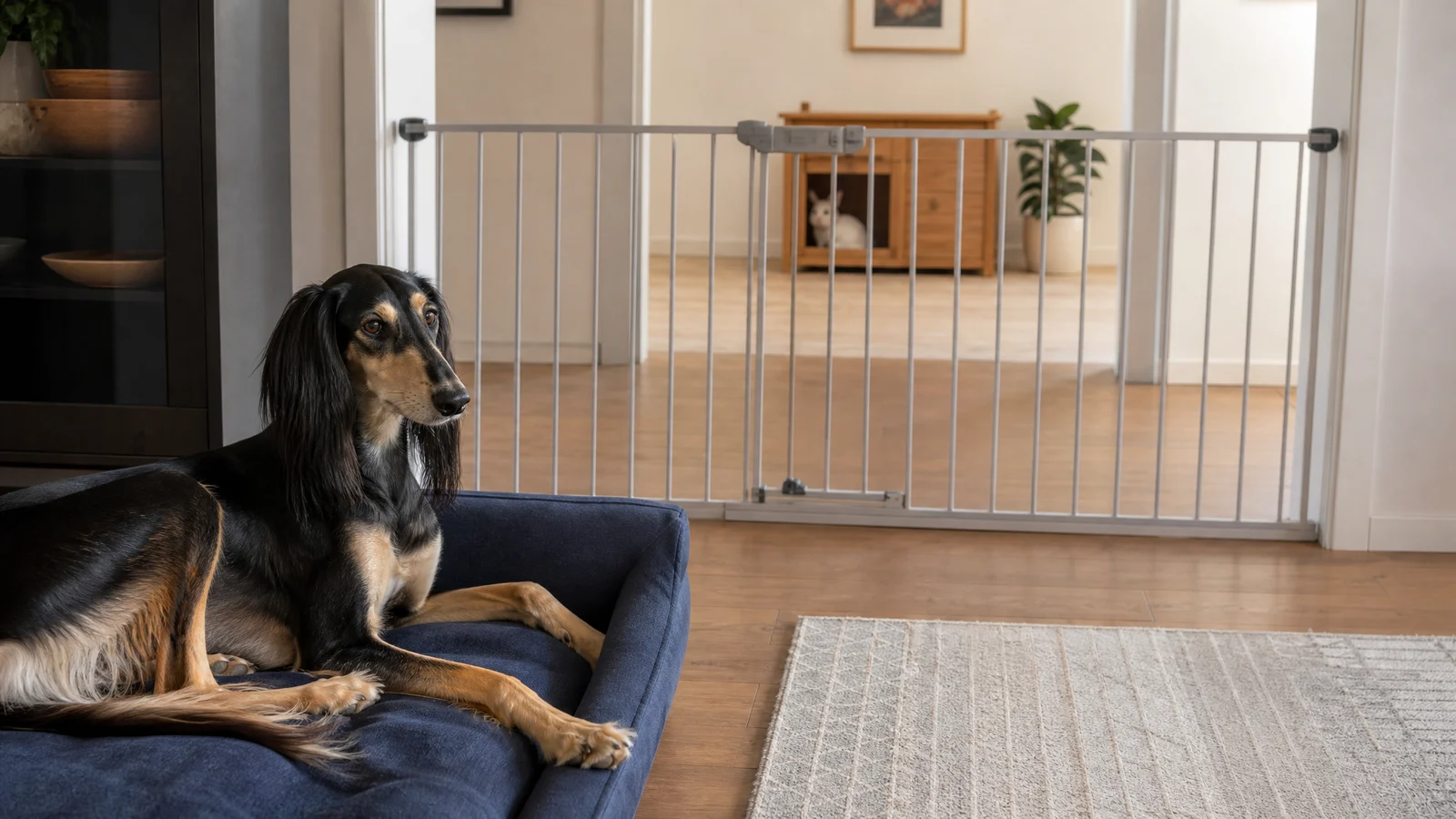
Living in the same home does not give a Saluki automatic access to a small pet. A gentle hound can still respond to a fast, low movement with pursuit, and familiarity does not erase that risk. The first promise to the smaller animal is a physical setup that works even when training has a bad day.
This guide defines protected zones, reads the Saluki's arousal and builds calm observation from a generous distance. We then organize short practice around barriers and decide what level of separation the household can sustain. Coexistence in a real shared home may mean permanent daily management, and that can be a fully responsible finished plan.
Small Pets at Home Need a Nonnegotiable Boundary
Begin with species-appropriate housing inside a room the Saluki cannot enter freely. Add a closed door or sturdy gate outside the enclosure so one human mistake does not create immediate contact. The smaller animal needs hiding areas and normal access to food, water and rest without the dog watching.
Do not rely on height alone. A hound may jump, push a light barrier or become more interested when an animal moves above eye level. Check latches, gaps, furniture placement and the route used to carry the small pet between safe areas.
The household should decide who opens each barrier and where the dog waits during care. Put supplies on the protected side so a person never leaves a gate open while searching for food or bedding. Clear roles matter more than optimistic reminders to be careful.
Test Every Small-Pet Care Route
The AVSAB management guide explains that management and training serve different jobs. In this home, barriers prevent a dangerous rehearsal while training builds calmer choices. Neither job makes unsupervised access appropriate.
Map failure points during a quiet walk-through. Carry an empty box along the normal route, open the room and practice closing each barrier while the Saluki is elsewhere. Fix awkward handles or blind corners before an animal is moved.
Include cleaning, feeding and emergency access in the map. A plan designed only for calm evenings may fail when bedding spills or a caregiver arrives late. Every routine should place the Saluki securely before work begins.
Keep direct supervision active even with strong barriers. Listen for scratching, repeated pacing or contact with a gate and redirect the dog to another area. The barrier prevents access, while the person prevents fixation from becoming a daily activity.
Read a Saluki Around Small Pets at Home
Observe from behind two secure layers at a distance where the dog can turn away. Look beyond barking. A closed mouth, still body, forward weight, trembling or very slow stalking can signal intense focus even when the room is quiet.
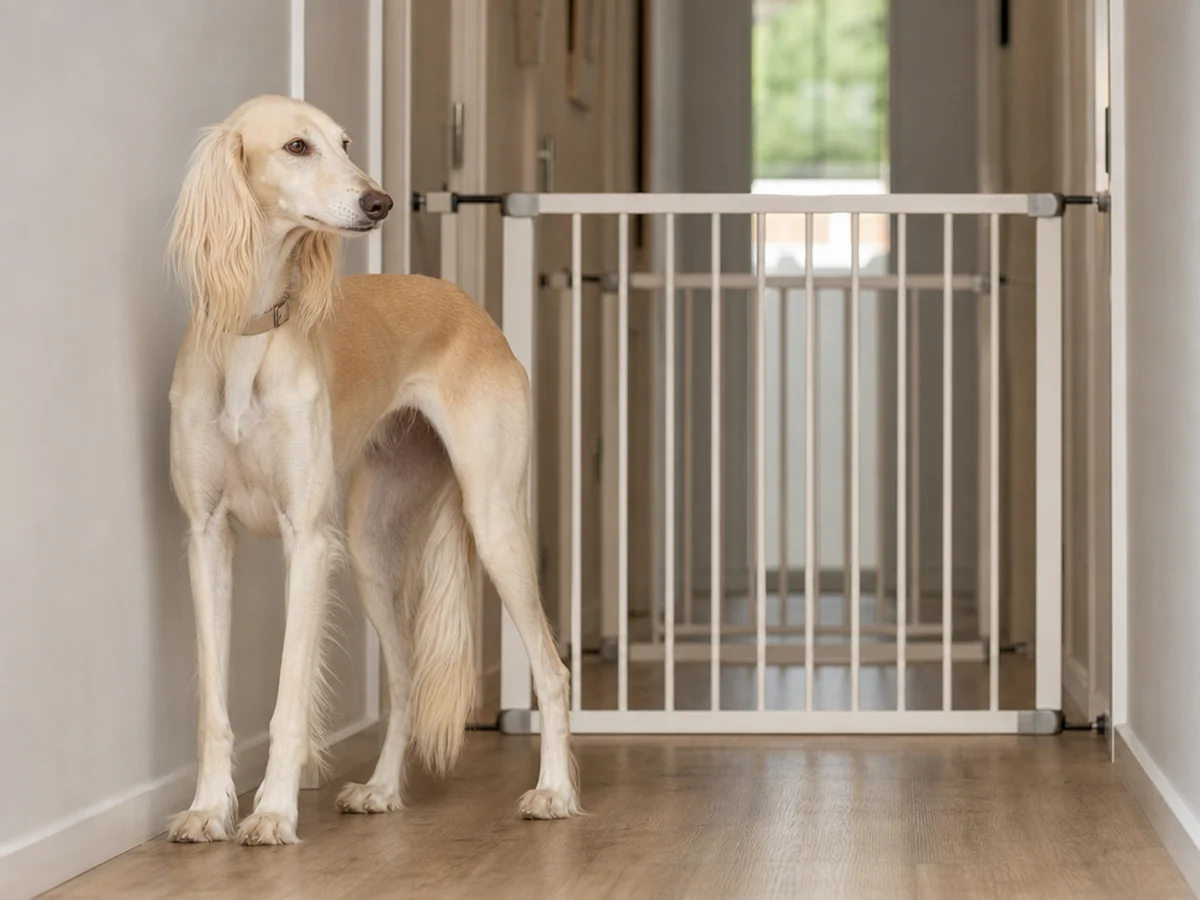
PDSA body-language guidance notes that small changes such as yawning or looking away can show discomfort. Here, turning away can also be a valuable choice. Reward it without asking the Saluki to look back at the animal.
Read Recovery After the Small Pet Leaves
Notice recovery after the small pet leaves view. A dog who resumes sniffing and rests offers a different picture from one who searches doors or patrols the room. Record the whole recovery because the absence of a lunge does not prove the exposure was easy.
End immediately if the hound cannot eat normally, respond to the handler or move away. Do not hold the Saluki in place so they must endure more movement. Increase distance and let ordinary behavior return before another session is considered.
The site's Saluki training guide helps families make rewarded boundaries consistent. The small-pet plan should be one of those daily rules, not an exception discussed only after the dog shows interest.
Separate curiosity from readiness. A dog who glances briefly may still chase when the animal runs, while a hound who settles during one session may struggle after an exciting walk. Each exposure is judged on current behavior.
Record what the smaller animal does too. Hiding, freezing, avoiding food or changing normal activity can show that the arrangement is stressful even when the Saluki appears calm. Safety includes the welfare of both animals.
Protected Zones for Small Pets at Home
Use layers that remain clear during busy moments. A closed room, secondary gate and leash on the Saluki may all be appropriate during the first practices. Remove a layer only when doing so has a purpose and does not reduce the smaller animal's safety.
Create a handoff routine for every person who cares for either animal. Say who has control before any barrier changes:
- Confirm the Saluki is behind a closed barrier before opening the small-pet room.
- Check that all enclosure latches are secure before changing the dog's location.
- Move carriers or supplies along the rehearsed route without leaving doors propped open.
- Tell the next caregiver which animals are secured before handing over responsibility.
- Return keys, leashes and treats to one fixed location after each transition.
Post the sequence where it is used. A visible routine helps guests and household members who are tired or distracted. It also makes it easier to identify which step needs redesign when a near miss occurs.
Separate Rest, Feeding and Active Care
Keep high activity away from the shared wall or gate. A small pet racing during feeding can intensify the Saluki's interest, while the dog's pacing can distress the other animal. Move resting and feeding stations farther apart so both can disengage.
Do not use a muzzle as permission for access. Even a conditioned safety tool cannot prevent chasing, pinning or severe stress to a smaller animal. Physical separation remains the foundation regardless of equipment.
Have a contingency for damaged barriers and power outages. A spare closed room, secure carrier and contact list allow immediate separation while repairs occur. The plan should still function when the usual arrangement is unavailable.
Rehearse the contingency without moving the small pet. Walk the route, close each door and confirm the Saluki's temporary location. Practice reveals whether the carrier fits through the doorway and whether supplies are actually within reach.
Visitors need a simpler rule than regular caregivers. They do not open either animal's area and they ask before moving a gate. Limiting responsibility prevents a helpful guest from combining animals whose routines they do not understand.
Practice Saluki Calm Near Small Pets at Home
Training begins with the small pet fully protected and far enough away that the Saluki can move, eat and look elsewhere. Reward the dog for orienting to the handler, settling on a mat or sniffing the floor. The smaller animal is not used as bait for a closer approach. Quiet success ends before either animal becomes strained.
Begin With an Empty Protected Room
First rehearse the dog near the closed room when the small pet is safely located elsewhere. Walk past, pause on a mat and return to another part of the home. This teaches a route and a station without adding movement behind the door.
Add ordinary sounds at low intensity only after the route is easy. A helper can move supplies or open an inner enclosure while the outer door stays closed. Reward the Saluki for continuing the familiar station behavior.
Add a Brief View Through Two Barriers
Arrange a distant glimpse while one person handles the dog and another watches the smaller animal. The Saluki notices, then receives rewards for turning away and traveling back to the station. End after one calm repetition rather than waiting for fixation.
Change only one feature in later sessions. The small pet might move slightly, the view may last longer or the dog may begin farther down the hall. Combining those changes makes it impossible to know what pushed the hound over threshold.
Use the same departure route after every view. The Saluki turns, travels with the handler and completes an easy activity in another room. A consistent finish prevents lingering at the gate after rewards stop.
Use Movement Away as the Main Skill
Teach a cheerful turn-away cue in rooms with no small animal present. Say the phrase, move with the Saluki and reward in a different area. The response should carry the dog away rather than leave them facing the protected zone.
Apply it before staring develops. If the cue fails, use the leash and barrier to leave without repeating it. The next practice begins farther away and returns to an easier version.
The Best Friends distance example describes working where a dog notices a trigger without reacting, then moving away and rewarding. Although the context differs, the useful principle is the same: distance preserves choices. It never establishes that direct contact is safe.
Schedule rest after the session. Do not move immediately into window watching, vigorous play or another exposure. Recovery time lets the household see whether arousal truly fell or merely shifted to a different target.
The site's Saluki exercise plan can place running and enrichment elsewhere in the week. Meeting activity needs does not make contact safe, but it prevents small-pet observation from becoming the dog's main event.
Decide the Long-Term Small-Pet Plan
Judge the trend across many ordinary days. Improvement means the Saluki disengages sooner, follows the exit route and rests without searching. It does not mean the smaller animal should be released to test whether the dog has changed.
ASPCA safety information notes that warning signals may be extremely brief. Do not depend on a person noticing every signal before intervening. Durable barriers remove that impossible timing requirement.
Seek qualified behavior help after any breach, chase, grab or repeated inability to recover at a safe distance. Keep regular veterinary visits for every animal and report sudden changes in arousal, movement or tolerance. A professional can refine practice, but they cannot guarantee compatibility.
Review the plan after any housing change. New furniture, a relocated enclosure or a different caregiver can remove a protective layer without anyone intending it. Repeat the quiet route test before returning to the former routine.
Keep the written plan beside emergency contacts. Clear instructions help a substitute caregiver preserve separation without improvising under pressure.
The final household rule may allow calm observation during planned sessions, or it may require complete visual separation. Choose the version everyone can follow every day. Small pets remain protected, the Saluki receives appropriate activity elsewhere and nobody is asked to prove safety through contact.
 BehaviorCounter Manners for a Saluki With a Long Reach and a Good Nose
 Puppy trainingSalukis at 6 Months: Wobbly Confidence and Rewards That Still Work
 Training basicsAre Salukis Good With Kids?
