 Saluki
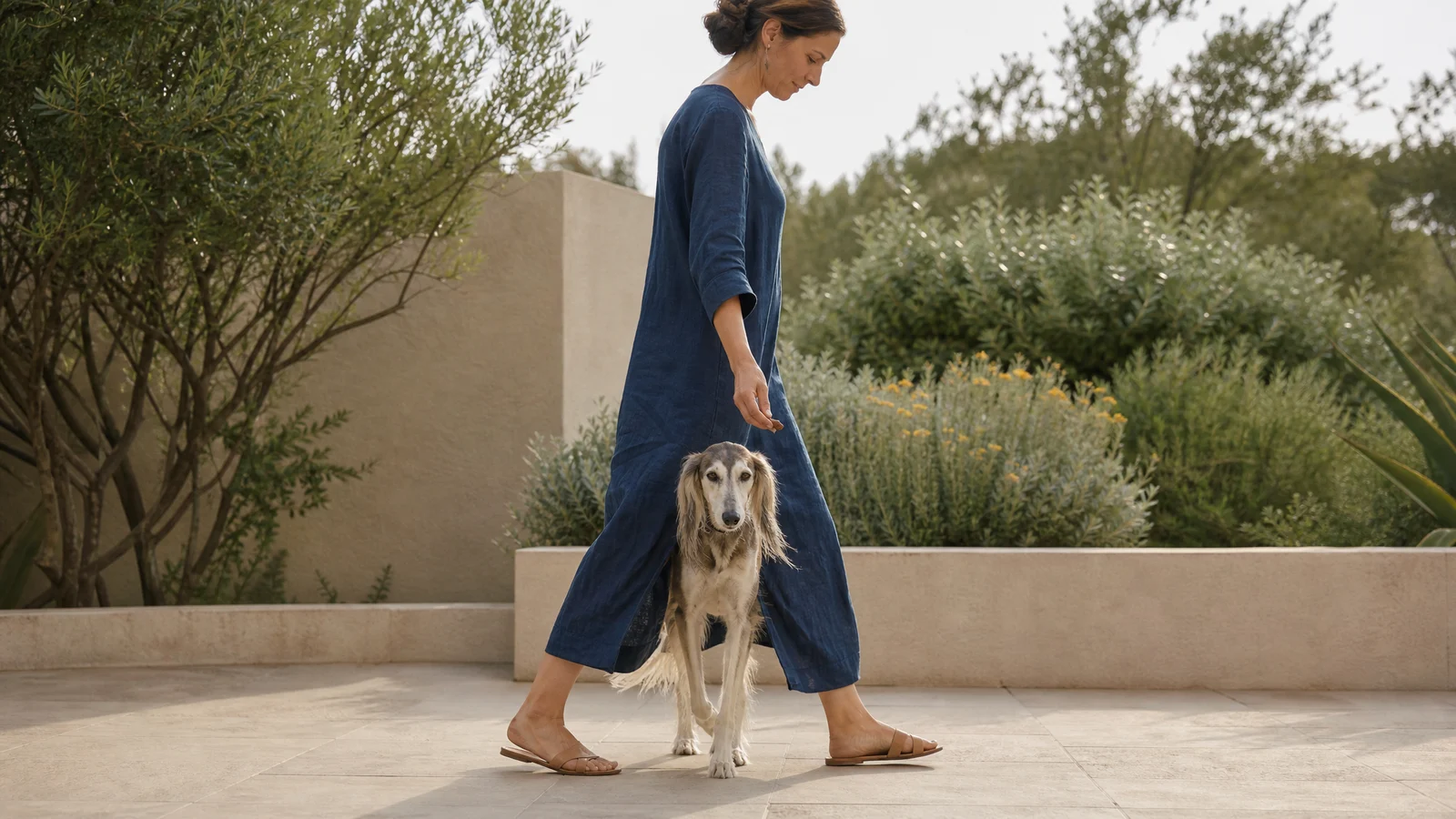
A Saluki who learns the leg weave learns to slow down on purpose, curving around you at a walk when the breed is built for straight-line speed. That makes it a calm, close-range job for a hound whose bigger games happen at a sprint, and it asks nothing of you but a wide stance, a pocket of small treats and a quiet floor.
The method is gentle: your treat hand steers your Saluki's nose, and the rest of the body follows. The part that needs thought is room, because a tall hound needs a wider gap than a small dog would, and a cramped one can make any dog hesitate.
Below, you'll find how to set up the floor and your stance, four short stages from a single pass to a full figure eight, how to swap the treat for a word, and what to do when your hound stalls.
Setting Up a Saluki Weave Trick for a Tall Hound
Room comes first in this trick, because your legs are the whole course and a tall dog needs space to fit through them. Saluki males should stand between 23 and 28 inches tall at the shoulder, and females may be considerably smaller, so build your stance around the dog in front of you.
Plant your feet wider than your shoulders, soften your knees, and bend until your treat hand can sit low behind one leg. If your hound's shoulders brush your calves on a pass, widen the stance before the next try, because a tight gap turns a friendly game into a squeeze, and a dignified, independent hound may simply decline.
Pick a room with a door you can close, and take the leash off first, since a leash can easily wrap around your leg mid-pass. With a Saluki the closed door matters twice over: with no leash on, it is the only thing between a fast hound and the outdoors, so shut it before the first treat comes out.
Make it the quietest room you have, too. The San Francisco SPCA suggests beginning tricks in a distraction-free environment, probably indoors, which for a hound who notices every flicker outside means the blinds down and the television off. Keep small, soft treats in a pouch, and choose one marker word, such as "yes," before you begin. The word tells your Saluki the exact moment they earned the treat, and that information is what the whole method runs on.
Four Stages That Build a Saluki Weave
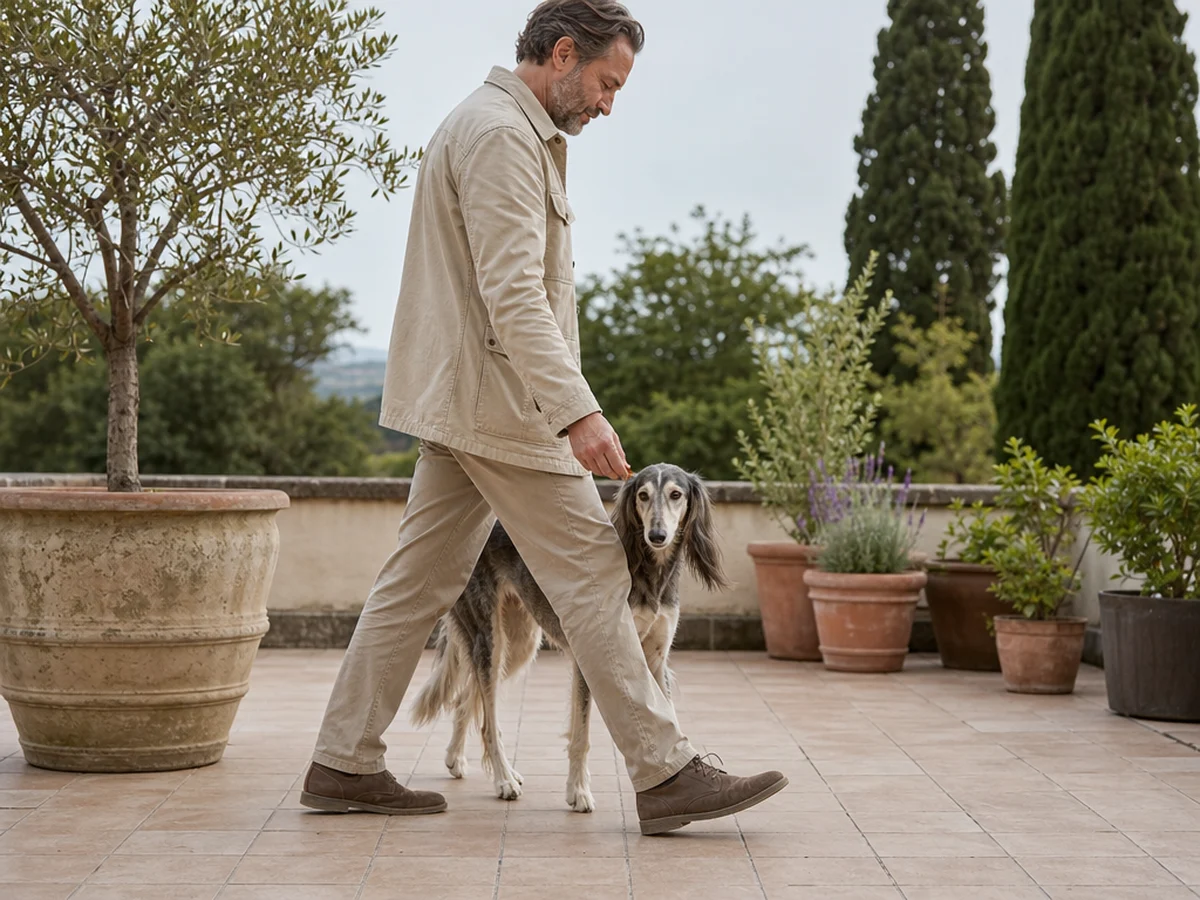
With the room ready, the weave comes together in four stages, and the rule between them stays the same: move on only when your Saluki does a stage smoothly several times in a row, and drop back a step if they stall. Each stage says where your hand goes, when to mark and what to try if your hound stops.
One Pass Through the Gap
Stage one is only a walk through the gap, and it sets the pattern for everything after it. Your Saluki starts in front of you, facing you, while you stand with your feet wide and your treat hand tucked behind one leg, because a lure that arrives from behind draws a dog forward through the gap, where a hand pushed in from the front sends them backward.
- Set the lure. Let your hound sniff the treat in your hand behind your leg, then draw it back and low through the gap, keeping it close to their nose.
- Follow the nose: As your Saluki steps between your legs, bend your knees a little so their shoulders clear, and move your hand at the pace of the dog's walk.
- Mark and Pay: The moment your hound's head clears the gap, say your marker word and give the treat, then let them eat it behind you.
- Turn around to face your hound, which puts them in front of you again, and settle back into your wide stance so the next pass starts from the same place.
Timing matters more than speed here, because a reward that arrives within seconds of the behavior is one your hound can connect to it, while a late reward may not be linked to the right action. If your Saluki hesitates at the gap, move the treat closer and pay for the first step toward it, then ask for a little more each time.
Around the First Leg
Stage two adds a curve: your hound passes through the gap and keeps going around one leg until they are back in front of you. Start with your right leg unless your Saluki plainly prefers the other side.
- Begin as in stage one, with your hound facing you and the treat hand behind your legs.
- Lure through the gap, then sweep your hand around the outside of your right leg so your Saluki follows in a wide curve back to the front.
- A lick or a nibble at the treat on the way around is fine, since it keeps your hound with your hand through the turn.
- Mark and pay when your Saluki is standing in front of you again, not partway round the curve.
A tall hound draws a wider loop than a small dog, so give the curve room rather than tightening it. If your Saluki cuts back through the gap instead of circling, hold the treat further out beside your leg and pay for any step around it.
Around the Other Leg
Stage three repeats stage two on the left, and it needs its own practice because it is a new lesson for your hound: the guiding hand, the leg being circled and the direction of the turn have all changed. We see hounds treat the two sides as separate puzzles, so begin again with a single pass through the gap, then lure around your left leg and pay in front.
If one side comes easier, give the other extra passes before you move on, because the figure eight is only as smooth as its weaker half. When the second side stalls, step back to a plain pass through the gap and build up again.
A Saluki Figure 8 Through Your Legs
Stage four joins the two loops into one figure eight, and the only new rule is that the treat waits until both loops are done. That one change is the hard part, because your hound has been paid after every curve so far.
- Lure through the gap and around your right leg to the front, exactly as in stage two.
- Without pausing to pay, lure straight back through the gap and around your left leg, so your hound draws a figure eight around your legs.
- Mark and pay when your Saluki arrives in front of you after the second loop.
If your hound stops after the first loop, pay there, go back a step and ask for the second loop on its own before you try the full pattern again. A stop there usually means the chain grew longer than the pay your hound was expecting.
Emptying the Hand and Putting a Word on the Weave
Stage four ends with a hound who follows food, and the next stage asks them to follow you instead. Keep the same path but lead with an empty hand, and pay from your other hand or a pocket the moment your Saluki finishes the pattern. Your hound is now following the motion of your hand, so keep your movements as slow and wide as before.
When the empty-hand weave is smooth, say your word once, such as "weave," pause a beat, and then start your hand. We find the word lands best when it arrives before the gesture, because your hound can then begin to move on the word and let the hand become a hint.
Shrink the hand a little at a time until your bent knees and a small gesture are enough, and thin the treats gradually too, so the weave never feels as if it stopped paying. A walking weave is an optional extra for later: take one slow, large step between loops, bring a treat back to your hand to keep your Saluki confident, and fade it again as you did before.
When the Weave Stalls Halfway Through
A stall is useful information, because where your Saluki stops shows you which stage needs another round. The four situations below work as a short map from symptom to fix, and it pays to change one thing at a time.
Frozen in the gap. A hound who stops between your legs often finds the space tight or the position odd.
Widen your stance, bring the treat nearer and pay for any step toward the gap. If a reserved young Saluki seems uneasy about legs close by, spend a few sessions on grooming and handling practice and socializing a reserved puppy first.
Swinging too wide: A tall hound's loop is naturally wide, but a loop that drifts away from your leg has lost the lure. Hold your treat hand close to your leg line and low, and pay for the tighter curve. Grabbing the Treat: A hound who snatches at your fingers is trying to hurry the game. Keep the treat low with your fingers closed around all but the tip, and let your Saluki nibble as they travel rather than lunge.
Leaving after one pass often means the session has run long or the room has grown busy, so end it there, pay one last easy pass and try again later in the day, when the room is quiet and your Saluki has had time to settle.
Questions to Settle Before Your First Weave Session
A few decisions sit outside the stages, and each is easier to settle before the first treat comes out than halfway through a lesson, when a wrong guess costs you a muddled session.
Do we need a marker word first?
Yes, choose one before stage one. A short word you never use in everyday talk, said at the instant your hound clears the gap, tells your Saluki exactly what earned the treat. A clicker does the same job if you already use one.
Should we practice before or after a run?
Pick a time when your Saluki is relaxed rather than wound up, which is often after a safe sprint in a fenced area has taken the edge off. The weave asks for slow curves, and a hound still buzzing from a long chase may rush the gap.
Can an older Saluki still learn the weave?
Yes, as long as turning in tight curves is comfortable for them. Mention the trick at your regular veterinary visits, and if your Saluki ever seems stiff or sore while stepping through or turning, stop and call your veterinarian before you ask again.
A Saluki Lesson Without Leash or Fence
Much of a Saluki's training is built around a safety layer, with a leash on the walk, a fence around the run and a long line for anything that tests the recall. The weave sits apart from all of that: it happens loose, in a closed room, with nothing clipped to your hound at all, and the closed door is the only fence it needs.
Keep it that way. A weave belongs in the room where you taught it, because a hallway with the front door open turns a quiet game into a risk for a hound ready to chase whatever moves.
A closed hallway is room enough for a great many more lessons, and our Saluki e-book picks up every other thing a tall, independent hound needs to learn, covering each need in full and in everyday terms. Type your email into the box here and the copy comes to you by message.
 Exercise and jobsHow to Teach a Saluki to Jump Over Obstacles
 Training basicsIs a Saluki the Right Dog for You? What Training Takes
 Training basicsHow to Choose a Saluki Trainer
