 Saluki
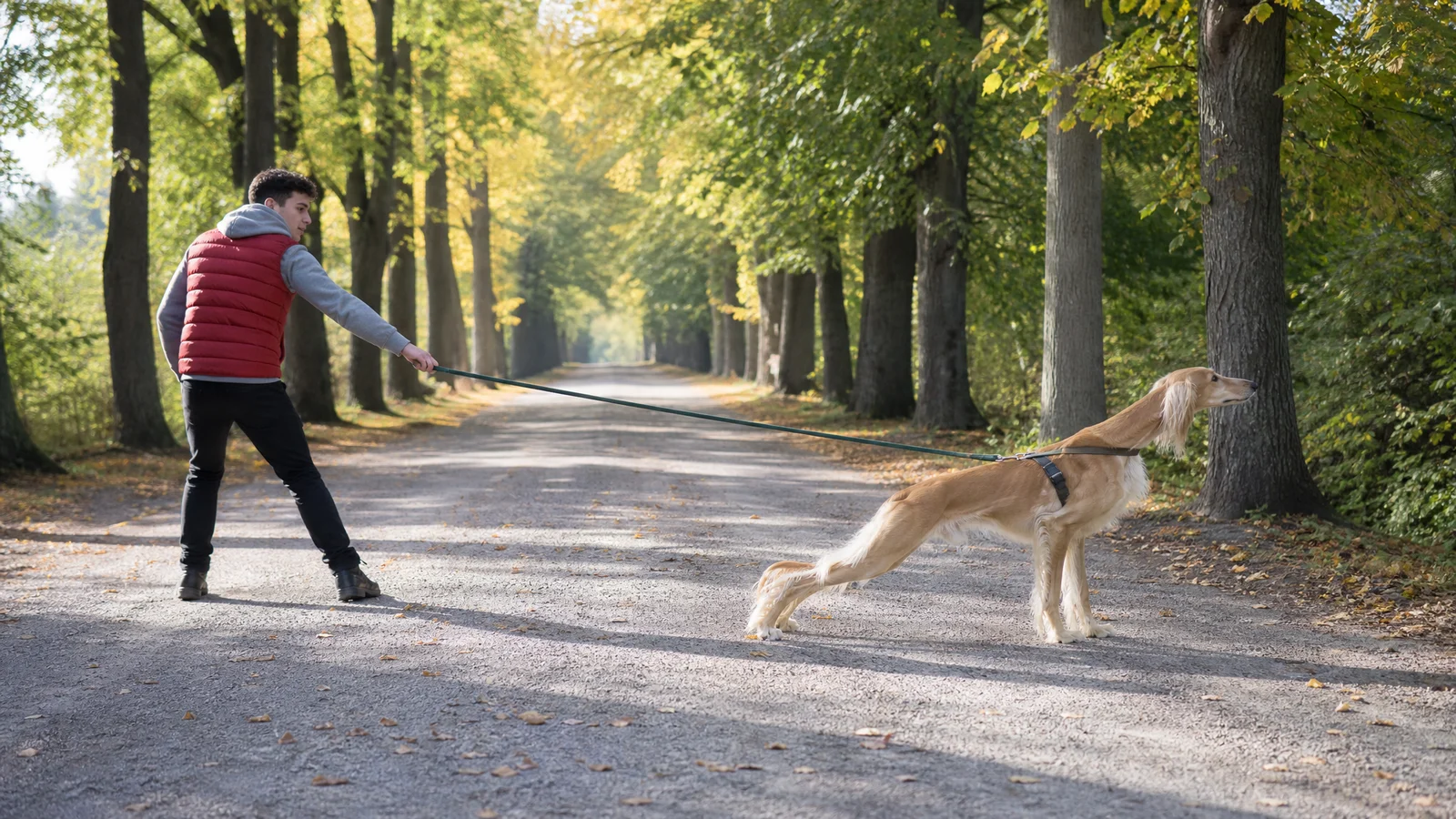
A leash is the one piece of safety gear a Saluki walk cannot do without, so a tight one is more than a sore shoulder. It is the only thing standing between a hound who is always ready to chase whatever moves and the street.
Pulling is learned the way most habits are: the line goes tight, the walk keeps going, and the horizon gets a little closer. That means it can be unlearned, with no force at all. The repair is to make tension earn nothing and slack earn everything, using a stop, a turn and a well-timed treat.
Read on for the three stages and for how they hold up when something far away takes over the walk. We start with why the habit lasts, because the reason shapes every step that follows.
Why Pulling Pays Off for a Saluki
A habit lasts because something keeps paying for it, and with your Saluki two things do. The two work together, and seeing them is half the fix. Here they are, one at a time.
- The first is plain mechanics. Every time the line tightens and you keep walking, the lean is rewarded with forward motion, and walks repeat that exchange again and again until it feels like part of the dog.
- The second payment belongs to sighthounds. A Saluki is built to notice movement a long way off, so a pull often has a destination: a cyclist, a bird lifting off a lawn, a dog crossing a park. That is why the same hound who strolls on a slack line in the hallway can lean hard the moment something moves. The lean now has somewhere to go.
Seeing both payments tells you what to change. An independent-minded hound rarely trades a lean for a scolding, and a scolding gives neither payment a reason to stop. What works is quieter. The line stops buying forward motion, slack starts buying it instead, and you teach that first where nothing is moving and then where everything is. The three stages below are that plan with the detail filled in.
A Saluki's Gear, Treats and Starting Place
If tension and sight are the two payments, the setup has one job: remove everything that competes with you while the new rule is still fragile. It is a small job, but it decides how the first session goes.
Use an ordinary fixed-length leash you can hold comfortably, and fill a pocket with small, soft treats that are quick to swallow and worth more to your Saluki than whatever waits outside. Then pick the quietest room you have: a hallway, a spare room, or a fenced yard with nothing moving beyond it. As Saluki people, we trust a hallway over a sidewalk at this stage, because nothing in a hallway gives the lean a destination.
Before each practice session, run through this short list. Each item protects the lesson from an avoidable failure.
- Check the fit. A collar or harness that slides off when your hound backs away or spins ends the lesson before it starts.
- Treats in reach: a small handful in a pocket or pouch, ready before the leash comes out.
- A quiet start with no street view, so there are no windows or open doors for your hound to aim at.
- Time to spare. A lesson that ends in a hurry tends to end on a tight line.
None of that takes long. Together it keeps the first lessons from being lost to a loose collar or a window full of passing traffic.
Stop Saluki Pulling in Three Stages
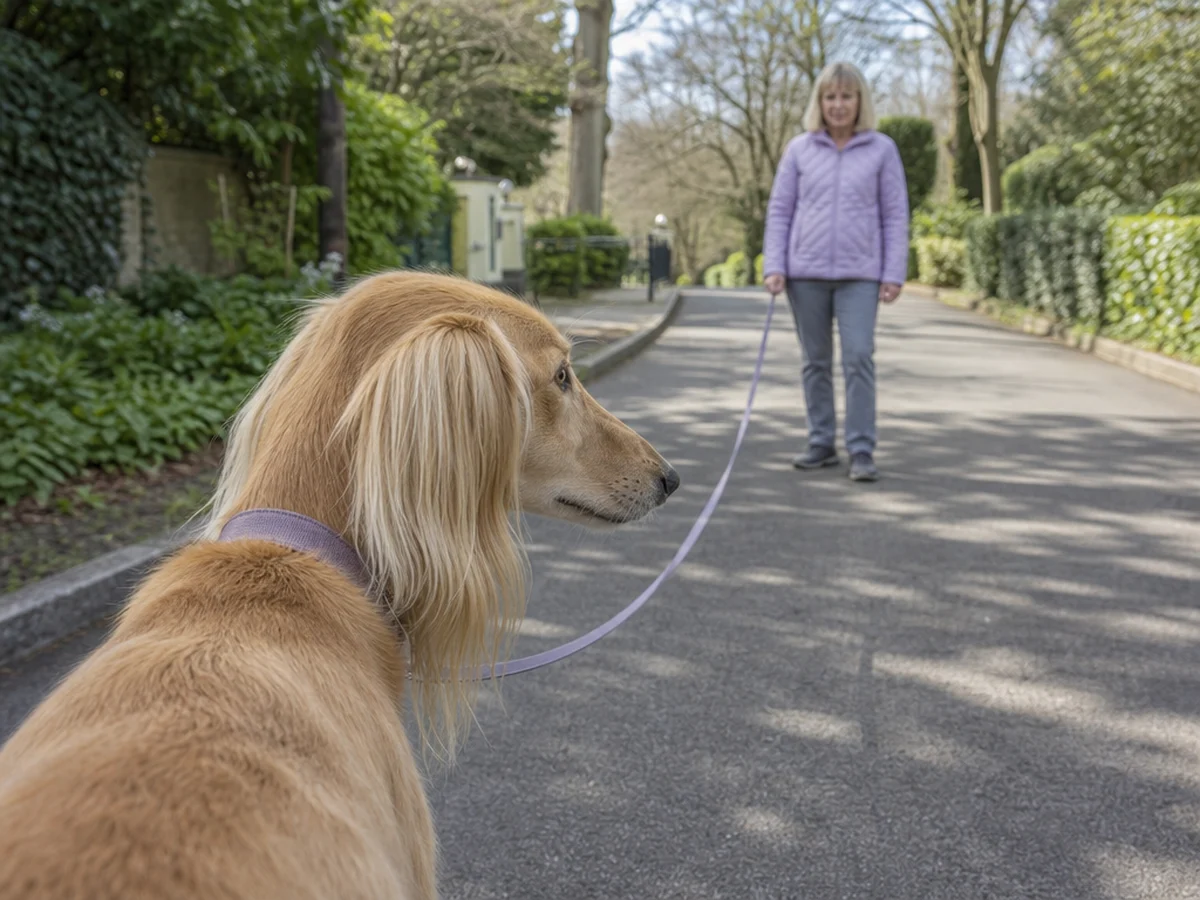
With the room ready, the plan is three stages that share one rule: a tight line stops the walk, and a slack line restarts it. Each stage makes the same rule harder to follow. You move on when a stage looks smooth several times in a row, not when a certain number of days has passed.
First, Stop and Wait
Every pull is your cue to stop. Stand still and wait for your Saluki to come back toward you before you move forward again, which is the same stop-and-wait routine trainers use alongside a gentle leader or front-clip harness for managing pulling. Gear can lend a hand while the habit changes, but it does not teach the lesson, so the stop is still your job.
Here is the whole sequence, starting in the quietest room you have. Each step is small on purpose, so the first successes come quickly.
- Clip on the leash, hold the handle in both hands low at your belt, and start walking with a treat ready in one hand.
- The moment the line tightens, stop. Plant your feet, keep your hands still and say nothing.
- Wait. Your Saluki may lean, look around, sigh or step back toward you, and any softening of the line counts.
- As soon as the line sags, say your marker word, feed a treat beside your leg and walk on.
That is one repetition, and the stop does the teaching: it costs your hound the one thing the pull was for, while the treat shows exactly what to do instead. Expect the early minutes to feel slow. A long-striding hound can cover a hallway in a few bounds, so you may stop more than you walk, and that is normal for this stage.
Second, Turn and Pay
Sometimes waiting alone does not work. Your Saluki stays at the end of a straight line with eyes fixed on a door, and the stop only makes the lean longer. When that happens, turn and walk the other way, which puts your hound behind you for a moment, and pay them as they swing around to follow. Do it every time, too: if you stop only four out of five times, your Saluki learns that pulling can still get them moving.
The turn also helps a hound whose eyes are locked on something ahead. It breaks the straight line between your Saluki and the thing they want, and it hands them a new job, which is following you. Keep your voice light and your turns smooth, and feed beside your leg rather than out in front so the treat teaches position as well as slack.
Third, Pay Slack Beside You
Once stops and turns are working, stop only fixing mistakes and start paying for what you want. Walk a few steps, and each time the line sags while your Saluki is beside you or just ahead, mark and feed. Early on that means a treat every few strides. Later you pay less often and sometimes change your pace, so slack stays interesting rather than predictable.
When slack has become the usual answer, you can name it with a quiet "easy" just before you pay, so the word predicts the treat instead of begging for it. This stage is where the walk starts to feel different, because your hound has found a place to be that pays, and it does not have to be at your knee. Beside you or a little ahead are both fine, as long as the line is soft.
Taking Pulling Practice Past the Front Yard
A Saluki who walks beautifully in the hallway has learned the rule in one place, so the next job is teaching it where the pulling actually started. Climb one step at a time: the hallway, then a fenced yard, then the quiet end of your street, then busier stretches.
Short lessons work best. Aim for around five to ten minutes and finish while your hound is still doing well, and vary your route now and then so the lesson carries from place to place. A young hound's focus will come and go, which is normal; our guide to a Saluki at six months covers rewards that still work in that stage, and a short practice walk fits easily into a Saluki puppy daily routine.
If your Saluki starts straining again, the place or the timing is too hard for now. Add distance from whatever is moving, pick a quieter route or pay more often until the line softens. Regular veterinary visits belong in the plan too: if your hound's walking changes suddenly, or a lean looks uncomfortable rather than eager, ask your veterinarian before assuming it is only training.
Signs a Level Is Ready
These signs tell you a level is ready for a harder one. You do not need every one of them on the same walk.
- Slack arrives on its own within a few strides of starting out, without you stopping to ask for it.
- Stops get shorter: the line sags almost as soon as you stand still, so each lesson wastes less of the walk.
- Your hound glances back at you before the line has a chance to tighten.
- Treats come less often, and the walk stays soft anyway, which shows the habit is moving into the dog.
When most of these show up on the same walk, make the next walk a little harder. A single bad stretch is a reason to ease the setting for a day, not a sign that the earlier work is gone.
When Pulling Starts With a Sighting
Everything so far worked because you chose the difficulty. A sighting takes that choice away, and for a Saluki it can arrive from a very long way off.
A Leash Pulling Solution for Sudden Sightings
The best moment to act is before the line tightens. Watch your hound's head and ears on every walk, and when they lock onto something far away, turn and walk away from it before the lean begins. That is the stage-two turn, only earlier, and it works because you are still at a distance where a treat can beat the view.
If the line is already tight, hold the handle steady in both hands and wait. A hound who is staring may not take food at all, and that tells you the distance is too short. Add space until the treat is interesting again, then pay for slack. A cyclist at ten feet can easily beat a treat, so do not expect otherwise, and keep a secure grip, because a fast hound can cover a lot of ground in a moment.
When a Pull Becomes a Lunge
A steady lean is a habit. A lunge, especially one with barking, a frozen stare or a braced, stiff body, is a bigger problem than leash manners, and these stages will not fix it alone. Increase the distance from whatever set it off, stay calm, and ask a qualified, reward-based trainer for a plan built for reactive walks. If lunging appears suddenly in a hound who never did it before, mention it at your next veterinary visit as well.
Loose Ends in Your Pulling Plan
Three practical details decide whether the stages hold up on a real walk: what pays when food loses, what your hands do while you wait, and where your hound's running fits in.
What if my Saluki ignores treats outside?
Outdoors the scenery competes with the treat, and a hound who is looking at it may not take anything. Move farther from whatever has their eye, make the treat better, or change the reward. Teaching a cue for exploring on a loose line can pay as well as food, because the chance to investigate is a reward in itself. Say your release word, such as "okay, go," and let your hound investigate while the line stays soft.
Where should my hands be during a stop?
Hold the handle in both hands, low and close to your belt, and let your feet do the stopping. A stop that comes from a tug on the line gives your Saluki something to lean against, while a stop that comes from you standing still gives them nothing to push on.
Do practice walks replace running?
No. A practice walk is a lesson, not your hound's exercise for the day, and a Saluki still needs outlets built for speed. Keep the lesson short and on a leash, as every Saluki walk should be, and give the sprinting its own time in a securely fenced space.
Slack Is a Length, Not a Short Leash
Those answers point at the same target, and it is worth stating plainly after so many stops and turns. A loose leash is not a short one. The goal is a line that sags between you while your Saluki ranges the whole length of it, ahead, off to one side, with nose and eyes wherever they like. What you have been removing all along is strain, not distance.
So spend that length on purpose. Where the place is safe, your release word can send your hound to the end of a soft line, and for a breed that lives to look far away, that can be as good a payment as a treat. In a busy or open place, shorten the line and keep your hound close. Either way, the lesson stays the same: the line goes soft first, and the distance follows.
Once the leash lessons feel settled, our Saluki e-book maps the training that comes next, in plain terms and with the same patience you have been showing on the sidewalk. Hand us your email address and the book is yours, with no payment asked.
 Exercise and jobsEasy Tricks to Teach a Saluki
 Exercise and jobsHow to Teach a Saluki to Shake and High Five
 Exercise and jobsHow to Teach a Saluki to Spin
