 Saluki
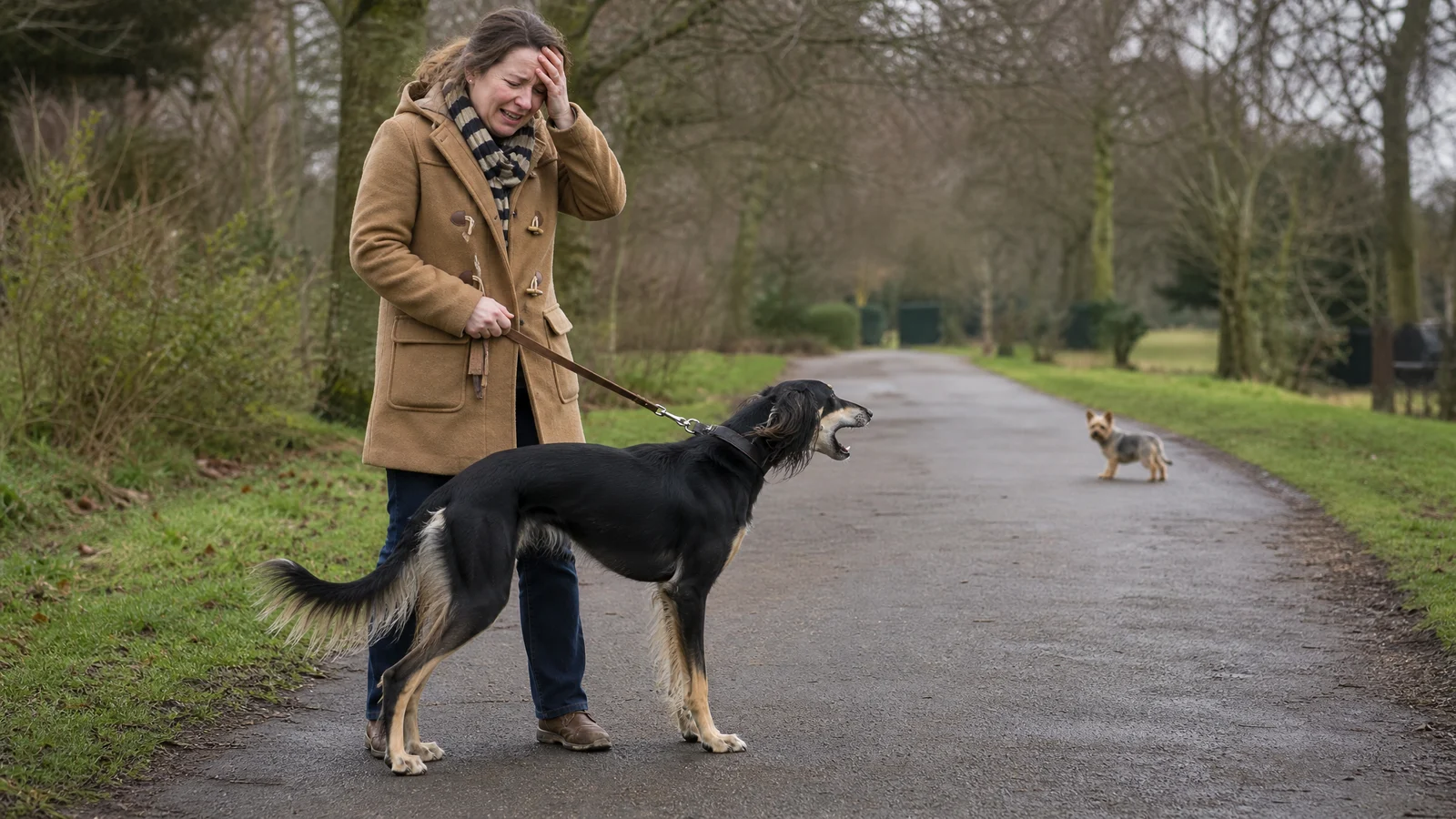
Your Saluki has locked onto a jogger half a block away while you are still deciding which way to turn. By the time the leash tightens, the barking and lunging have already started.
That scene has a calmer fix than it feels like in the moment. Help comes from three ordinary moves: more room between your hound and whatever set them off, an exit you can take before the reaction peaks, and a steady supply of rewards for every time they notice something and stay with you. A sighthound complicates each move, because a Saluki spots triggers long before most dogs do, and a leash gives a dog built for speed nowhere to go.
Read on for what the leash does to a sighthound's reactions, how to measure the room your Saluki needs, and the practice that changes how a trigger feels. None of it asks your hound to stop noticing the world, only to notice it from a better distance.
Why Reactivity Gets Louder on a Saluki's Leash
Behind most barking, lunging walks sits a dog who has run out of options, and the leash is usually what took them away. Reactivity means a dog responds to a trigger, such as another dog, a stranger, a bike or a cat, far more strongly than the moment calls for. On leash, the choices a dog would use to handle that trigger alone, like moving off or taking a wide curve, are gone.
That is more than a feeling we attach to leashes. The guidance from Fear Free notes that some dogs are worried on leash because they feel confined with no means of escape, and that a tight leash can make a dog feel as if there is no escape from a frightening situation. So the strain you feel through the handle can be a dog trying to get away as easily as a dog trying to get closer.
Two Engines Behind One Lunge
A Saluki arrives at that leash with plenty of instinct. These are dignified, gentle and independent-minded dogs, and training one may take patience and consistency because they are always ready to chase after anything that moves. A lunge at a passing dog can be exactly that readiness meeting the end of a short line, with a hound whose far-seeing eyes caught the trigger before you did.
The second engine is reserve. Salukis are reserved with strangers, so a person who walks straight toward your hound can set off a reaction that has nothing to do with chasing. From your end of the leash the two look alike: a stiff body, a fixed stare, then noise.
The plan below works for both, so you do not need to settle which engine is running before you start. You only need to notice which one shows up more often, because that tells you what to keep out of your route.
Mapping the Triggers Behind the Lunge
A reaction plan stands or falls on how well you know what sets your hound off, and most of us know less than we think. The first job is to identify the specific triggers that upset your dog, and the detail that matters most is context: some dogs react to a trigger in every situation, while others only do so on leash, in crowded spaces or at night. That is why one bad walk tells you little and a pattern tells you a lot.
A few lines after each walk are enough to build that pattern. Jot down these points while the walk is fresh:
- What it was. A dog on leash, a dog behind a fence, a stranger, a jogger, a bike, a squirrel or a cat can each be a separate trigger, so name the specific one.
- How far away: where your Saluki first noticed it, and where the barking or lunging began. The gap between those two spots is some of the most useful information you will collect.
- What the trigger was doing matters as well, whether it stood still, crossed your path, jogged past or came straight toward you.
- Where and when it happened. The time of day, how crowded the street was and anything else going on nearby all belong in the note.
Once you have a short run of notes, a shape tends to appear. One hound lunges at fast movers and shrugs at slow ones, another reacts to anyone who approaches head-on, and a third saves the noise for dusk. The shape tells you which parts of your route to change first and which triggers can wait.
Finding the Distance Where Reactivity Fades
Your notes show what to avoid, and the next question is how much room each trigger needs. Every reactive dog has a distance at which a trigger is noticed without a reaction, and inside it the dog begins to bark, lunge or freeze. Trainers call that line the threshold, and it is the most useful measurement in this whole plan.
A hound with far-seeing eyes makes the line harder to judge, because a Saluki can register a trigger well before you do. In our experience, a generous first guess serves a Saluki better than a tight one, so treat your first estimate as a draft rather than a measurement.
Signs You Are Inside the Line
Watch the moment your hound notices the trigger. A stiff body, a fixed stare, a stalled pace, a refused treat or the first whine all mean you are at or inside the line. The treat is the clearest test, since a dog who can still eat can still learn, and a dog who cannot is already reacting.
When you see those signs, add room until the food works again and make a note of the spot. Reacting at that point is practice for the reaction, which is why stopping early beats powering through.
Signs You Have Room to Work
A hound who notices the trigger, takes a treat and glances back at you is outside the line, and that glance is what you are building. The line also moves with the trigger. A dog across an open field can be easy while the same dog on the sidewalk is impossible, so test the distance again in each new place and for each kind of trigger instead of trusting last week's number.
Routes and Rest Days for a Reactive Saluki
A distance only helps if your walks let you keep it, and that comes down to choosing where and when you go. Other owners cannot see your hound's limits, so you have to be the defensive driver for both of you, watching ahead and leaving yourself room to change course.
Open Ground and Quiet Hours
Pick routes with long sightlines, wide verges and side streets, so you see a trigger early and can turn without a scramble. Walk when fewer dogs and people are out, and skip the dog park while you work on this, since a crowded, unpredictable place is the hardest setting for a reactive dog. A well-fitted harness and a standard leash serve you better than a retractable one, because a leash that can run out lets a fast hound close the gap to a trigger in a few strides.
Salukis still need to run, so give the sprint a home with no triggers in it: a securely fenced space, or whatever safe outlet you already use. Scent games and puzzle feeders at home fill the rest of the day without a single neighbor in sight.
Days Without the Hard Walk
Working near triggers is tiring for a reactive dog, so build in days when the walk is a quiet sniff somewhere easy, or when enrichment at home replaces the outing. Those days are part of the plan rather than a break from it, and they are fair to you too: on the days you are worn out, a home day is a legitimate choice.
Keep regular veterinary visits on the calendar, and mention reactions that appear suddenly or get worse, because a sudden change in behavior deserves a veterinary look before you decide it is only a training problem.
Counter-Conditioning Your Reactive Saluki on Open Ground
Room keeps a reaction from growing, and practice is what shrinks it. Counter-conditioning changes what a trigger predicts: instead of the trigger leading to a lunge, it leads to food, and over many repetitions your Saluki starts to look to you when something appears. Do it only outside the line you just found, because practice inside the line repeats the reaction, and the moves below keep each outing on the right side of it.
The Moves for a Practice Outing
Plan on one trigger in view at a time and a hound who is relaxed before you start. These moves keep your Saluki on the right side of the line while the meaning of that trigger slowly changes:
- Set the scene. Choose an open spot where a trigger can appear far outside your Saluki's line, such as a wide path with a clear view, and bring soft, smelly treats in a pouch so you can feed quickly.
- Feed on sight: the moment your hound sees the trigger, before any reaction, start a steady stream of treats. The order matters, trigger first and food second, so that the sight of the trigger becomes the thing that starts the meal.
- Stop the food when the trigger leaves view, or when you calmly walk your Saluki away, so the trigger and the treats clearly belong together.
- Repeat at the same distance until your Saluki sees the trigger, brightens and looks to you with a loose body. That readiness tells you the distance has become easy, so do not rush past it.
- Add a look game. When your hound looks at the trigger, mark it with a bright “yes,” bring a treat to their nose so their head turns away as they eat, then release the treat. They will look again, and you repeat, turning every glance into a quick payment.
- Close the gap a little only after several easy rounds in a row, and go back to the last good distance whenever your Saluki starts to stiffen.
Work through the list outing after outing, and keep each session short enough that your hound is still coping when you finish. A Saluki who ends on a calm note comes back to the next outing already expecting good things.
Moving Closer Without Rushing
Keep the pace slow: move closer to a trigger only a few feet at a time, checking your hound's comfort at each spot and backing off whenever they become stressed or reactive. It may be many weeks or months before a dog has the skills to work close to other dogs on leash, so the slow route is the real route.
If your Saluki stops taking treats, you have moved too close, so return to the last distance where food worked. If they eat but stay stiff and stare, the work is still too hard to learn from, even though nothing has gone wrong yet. A short, easy session teaches more than a long one that ends in a lunge.
When Home Practice Is Not Enough
Ask for outside help when reactions are frequent, getting worse or hard to get away from. Your veterinarian can rule out health causes and point you toward a qualified reward-based trainer or a veterinary behaviorist who will work with your hound in person.
A Practiced Turn for Surprise Passes
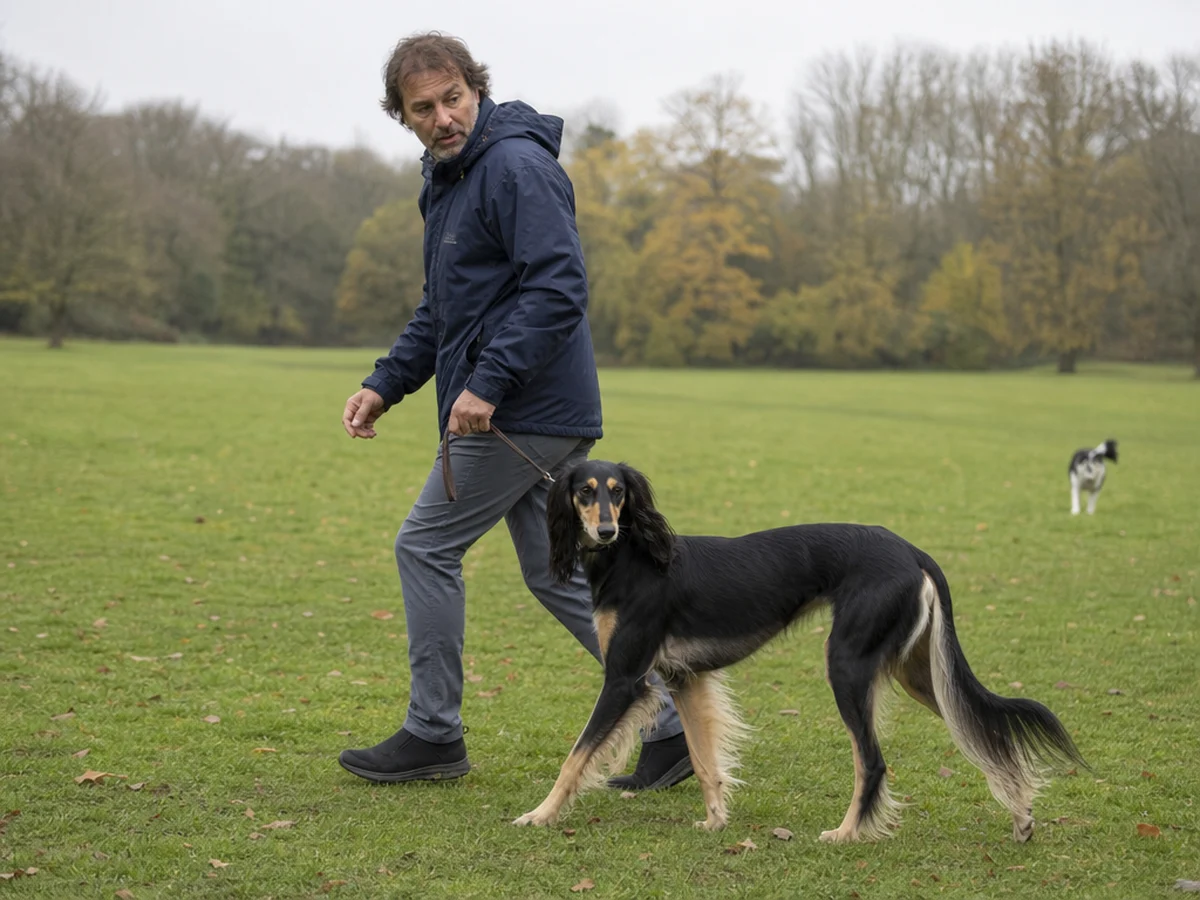
A Saluki's eyes are faster than any route plan, so some triggers will appear closer than you wanted. For those moments you need an exit your hound already knows, and the cheapest way to have one is to teach it when nothing is happening.
Teaching the Turn With Nothing Around
Pick a happy cue word, such as “this way,” and say it in a bright voice while you pivot and walk off in the opposite direction, patting your leg so your hound follows. Jog a short way, then pay with a treat. Repeat in the yard, in the hallway and on quiet streets until your Saluki swings around with you as soon as they hear the word, with the leash staying loose the whole time.
Using the Turn on a Real Street
When a trigger turns up closer than your plan allowed, say the cue early, before the reaction has built, and turn away in a wide, unhurried curve instead of stopping to watch. Keep the leash slack and your pace brisk. Pay as soon as you are out of the trigger's sight, then give your hound a quiet minute before deciding what comes next.
Skip the greeting even when the other dog looks friendly. A leash-reactive dog is unlikely to treat an approach as a social occasion, so a Saluki who is walked away calmly has lost nothing.
Reactivity Questions Beyond Other Dogs
The plan so far pictures a dog on the far side of the street, but Saluki walks serve up stranger cases. These three bend the plan without breaking it.
Is a squirrel the same problem?
Mostly yes. A small, fast mover sets off the same chase readiness, and the same plan applies: room, a treat the moment your Saluki notices, and a turn away. The difference is how short the warning is, because squirrels appear from nowhere, so keep your hound leashed or inside secure fencing. The guide to small pets and a Saluki covers cats and other animals at home.
What if an off-leash dog runs up?
Treat it as an emergency, not a lesson. Use your practiced turn, walk away calmly and call out in a clear, friendly voice so the other handler can call their dog back. Keep the leash slack as you move, since a tight leash can feel like a trap, and give your hound extra room on the next outing. If a close call keeps happening on one route, change the route.
Is reserved the same as reactive?
No. Reserve is quiet: a hound turns away, keeps their distance or declines a hello, and stays relaxed otherwise. Reactivity is loud and fast, with barking, lunging and a body that cannot settle. Reserve is part of the breed, so protect it with space rather than trying to cure it, and see socializing a reserved Saluki puppy for the early weeks.
Where Sight Turns Into Speed
A Saluki is built to turn sight into speed in an instant: the eyes find a movement, and the legs have already voted. The leash cannot change that, which is why reactions on a leash can look so sudden and so large.
What this page teaches is a gap between the two. Each time your hound spots a trigger and a treat arrives instead of a lunge, that gap grows a little, and a wider gap gives you room to turn, pay and walk on. It never has to become large to change your walks, because a Saluki who takes half a beat to look at you before anything else has already changed the whole encounter.
A hound who sees fast and decides faster needs more than polite passing, and our free Saluki e-book gives the whole of their training careful, thorough chapters that stay simple to follow. Sign up here and the e-book is delivered to your email.
 BehaviorHow to Stop a Saluki Pulling on the Leash
 Exercise and jobsEasy Tricks to Teach a Saluki
 Exercise and jobsHow to Teach a Saluki to Shake and High Five
